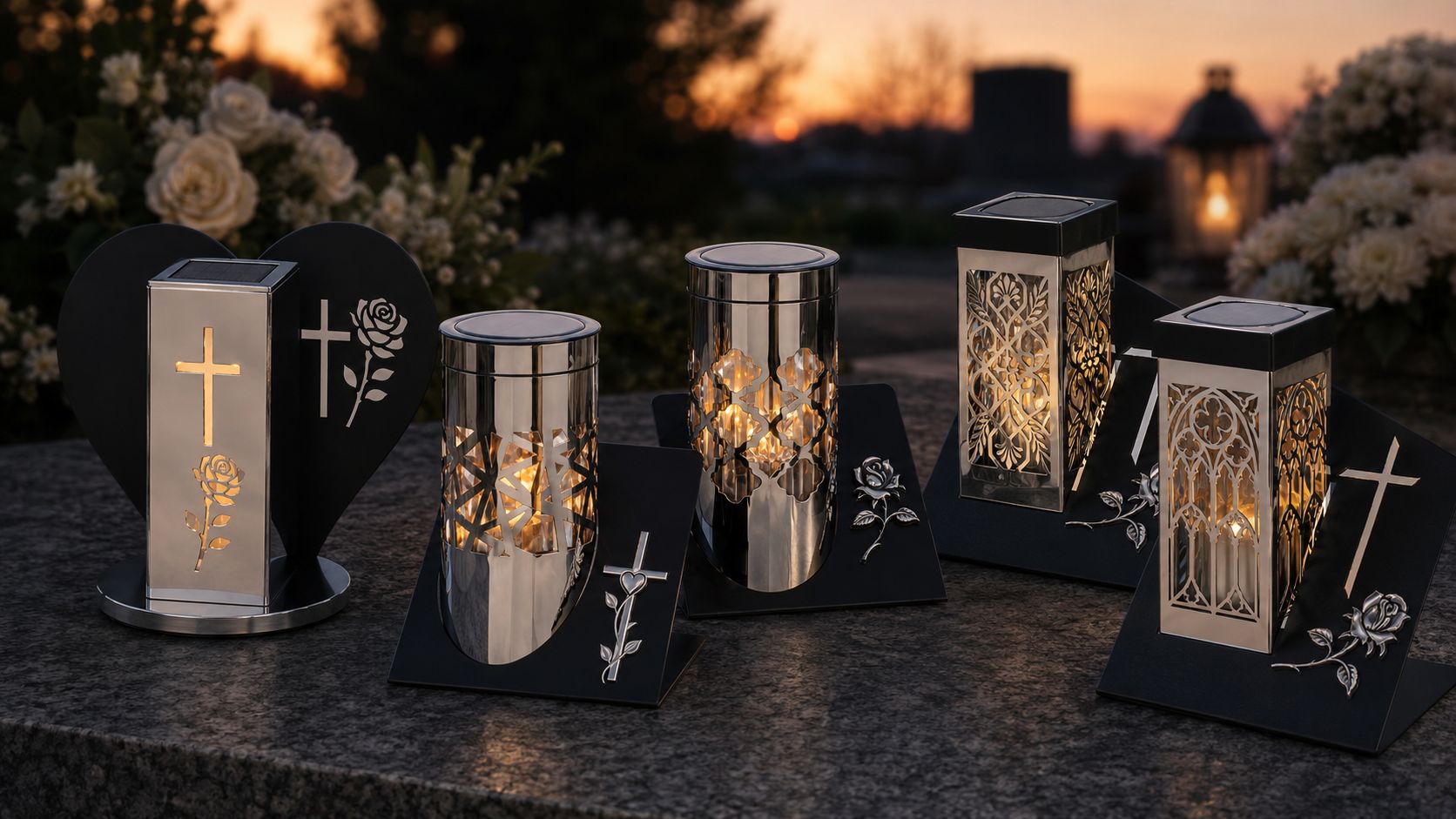
Choosing the housing material for a solar grave light should not begin with the question, “Which material is the best?” A more useful sourcing question is:
The right sourcing question
Which material combination offers the right balance of appearance, durability, transport performance, compliance and total cost for the target market, sales channel and intended service life?
There is no single material that is optimal for every solar grave light or solar cemetery lantern. Glass can support a traditional or premium product position. Plastic can reduce weight, simplify mass production and lower breakage risk. Metal can improve rigidity and perceived value. Decorative resin can reproduce religious figures, sculptural details, stone effects and complex ornamental forms.
However, no material can guarantee product durability on its own. The performance of a finished solar grave light also depends on:
the exact material grade;
wall thickness and geometry;
surface preparation and coating;
joint and fastening design;
sealing, drainage and condensation control;
solar-panel encapsulation;
battery chemistry and battery-compartment design;
LED, electronic-component and solder-joint quality;
packaging construction;
process control and production inspection.
Foryou Decor has worked in the home and garden decoration industry since 2005 and supplies lanterns, cemetery lanterns and customized B2B programs. Its published quality-control process includes pre-production sample confirmation, in-process inspection, final random inspection and shipment follow-up. This experience supports a system-based approach to material selection rather than treating the housing as an isolated component. [1-2]
Product objective | Typical material direction | Critical verification |
Traditional or premium positioning | Glass with properly protected metal | Glass edges, coating system, corrosion and packaging |
High-volume mass retail | PP, ABS or ASA body with PC or PMMA transparent parts | UV grade, wall thickness, impact and color consistency |
E-commerce distribution | Impact-resistant construction with validated packaging | Finished-pack drop and vibration performance |
Figurative or religious decoration | Defined outdoor resin system with durable pigment and coating | UV aging, moisture, freeze-thaw and coating adhesion |
Multi-season product | Serviceable construction with replaceable battery or module | Repeated opening, resealing and spare-part compatibility |
Balanced performance | Hybrid glass, plastic, metal and electronic construction | Interfaces, seals, adhesives, drainage and thermal movement |
These are design directions, not automatic recommendations. Final material selection should be confirmed through a written specification, documented material grades, reference samples, finished-product testing, packaging validation and controlled production.
A solar grave light is not simply a glass, plastic, metal or resin shell. It is a system of interacting parts that may include:
1. the main body and base;
2. a transparent lens or decorative panel;
3. a top cover and solar panel;
4. an LED light source;
5. a control circuit or dusk sensor;
6. a rechargeable battery;
7. a battery compartment;
8. wires, contacts and soldered connections;
9. switches;
10. gaskets, adhesives and fasteners;
11. drainage or condensation-control features;
12. individual and master-carton packaging.
A product may have a highly durable metal or glass body and still fail early because of:
water entering the battery compartment;
corrosion on battery contacts;
deterioration of the adhesive around the solar panel;
condensation reaching the PCB;
broken wires or solder joints;
loss of gasket compression;
an unsealed switch opening;
a battery that performs poorly at low temperatures;
an enclosure that traps rather than drains water;
loosening of components during transport.
Key sourcing principle
A strong housing material cannot compensate for weak sealing, poor drainage, an unsuitable battery or inconsistent assembly.
Material selection must therefore be linked to product architecture, testing, packaging and compliance from the beginning of the project.
Material | Typical application | Main advantages | Main risks | What the specification should define |
Glass | Lenses, walls, decorative panels, traditional and premium products | Traditional appearance, optical depth and high perceived value | Weight, edge damage and transport breakage | Glass type, thickness, edge finish, decoration and mounting method |
PP | Bases, housings and internal supports | Low weight and efficient high-volume molding | UV degradation of unsuitable grades, deformation and surface limitations | Grade, UV stabilization, wall thickness and recycled content |
ABS | Decorative housings and painted or plated components | Good surface quality, impact performance and paintability | Outdoor weathering of unsuitable grades and coating failure | Grade, UV strategy, coating, adhesion and wall thickness |
ASA | Colored exterior housings | Weatherability and color stability of appropriate grades | Higher cost than basic commodity plastics and grade dependence | Outdoor grade, color system, aging data and recycled content |
PC | Transparent lenses and impact-resistant covers | High impact resistance, strength and transparency | Scratching, stress cracking and yellowing of unsuitable grades | UV-stabilized grade, thickness, surface protection and chemical compatibility |
PMMA | Transparent lenses with high optical requirements | Clarity and strong weathering performance of suitable grades | Lower impact resistance than typical PC and geometry-related cracking | Grade, thickness, corner radii and mounting method |
Coated or galvanized steel | Frames, roofs, bases and decorative structures | Rigidity, familiar appearance and versatile finishing | Corrosion at edges, welds, holes, threads or coating damage | Steel grade, pretreatment, coating type and thickness |
Stainless steel | Premium structures and exposed metal surfaces | Appearance and corrosion resistance of suitable grades | Higher cost, staining and grade-dependent corrosion behavior | Stainless grade, surface finish, welding and passivation |
Aluminum | Lightweight frames, covers and premium parts | Low weight with anodizing and coating options | Galvanic corrosion, scratching and surface inconsistency | Alloy, surface treatment, thickness and metal isolation |
Decorative resin / polyresin | Angels, crosses, figures, reliefs and stone effects | Complex geometry and fine decorative detail | Fading, microcracking, moisture effects and coating failure in weak systems | Resin chemistry, filler, pigment, cure and protective coating |
Hybrid construction | Most developed multi-material products | Combines aesthetics, strength, low weight and cost efficiency | Leakage and failure at material interfaces | Joint design, gaskets, adhesives, tolerances and drainage |
The central sourcing lesson is that terms such as plastic, metal and resin are not sufficiently precise for a professional specification.
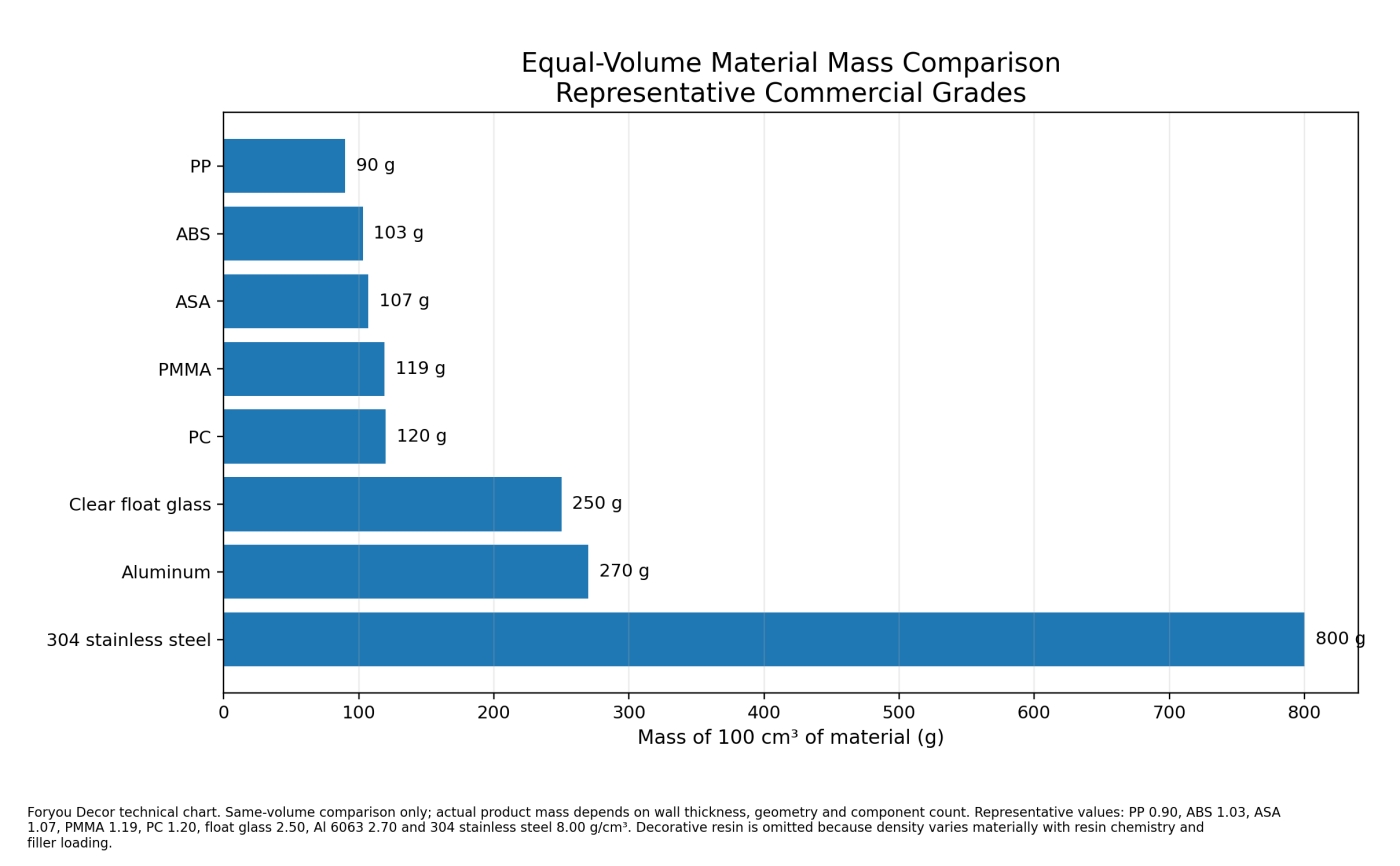
Figure 1. Equal-volume mass of representative solar grave light materials.
Data note: Representative published grades and material families. Same-volume comparison only; finished-product mass also depends on wall thickness, geometry and part count. Sources: [5], [7-10].
This comparison explains why material selection affects freight, carton design and handling. A transparent glass panel may still be commercially appropriate for premium products, but its density should be considered together with panel thickness and breakage protection. Aluminum can reduce metal-frame mass relative to stainless steel, while PP, ABS, ASA, PMMA and PC support lightweight molded structures. Decorative resin is not assigned a single value because filler loading and resin chemistry can change density substantially.
Glass is frequently selected for solar cemetery lanterns intended to resemble traditional grave lanterns or memorial candles. It can provide visual depth, a familiar European memorial aesthetic, a more substantial appearance, good light transmission and a higher perceived product value.
However, a glass product is not automatically a premium-quality product. Its performance depends on the type of glass, thickness, edge condition, support geometry and packaging.
glass type;
nominal thickness and tolerance;
permitted dimensional variation;
edge grinding or polishing;
acceptance criteria for chips and sharp edges;
permitted scratches, bubbles, inclusions or visual defects;
printing, coloring, frosting or coating method;
adhesion and abrasion resistance of the decoration;
how the glass is retained in the frame;
required assembly clearance;
cushioning and protection in the final packaging.
Glass may crack even when its nominal thickness appears sufficient if it is clamped too tightly, supported at only a few pressure points, assembled into a distorted metal frame, exposed to direct screw pressure, installed without adequate clearance or struck by loose internal components. Thermal expansion differences between glass, plastic, metal and adhesive can also create localized stress.
the product is positioned as traditional or premium;
the retailer accepts higher product and freight weight;
the visual target requires a classic lantern appearance;
packaging cost has been included in the commercial model;
breakage risk has been tested in finished packaging;
replacement and complaint costs have been included in total-cost calculations.
For e-commerce programs, the complete packaged product—not only the glass panel—should be tested under the agreed transport protocol.
The word plastic should not be used as the only material description in a request for quotation. PP, ABS, ASA, PC and PMMA differ significantly in outdoor weatherability, impact strength, surface appearance, optical performance, chemical resistance, molding behavior, cost, coating compatibility, stress-cracking sensitivity and recycling route.
Even products made from the same polymer family can perform differently because of grade formulation, UV stabilizers, pigments, fillers, recycled content and processing history.
Polypropylene may be suitable for bases, opaque housings, internal supports, battery-compartment parts, high-volume seasonal programs and products where low weight is important. Its commercial advantages can include efficient injection molding, relatively low density and broad availability.
However, “PP” does not establish whether the material is suitable for extended outdoor exposure. The buyer should establish:
homopolymer or copolymer;
exact resin grade;
UV stabilization;
pigment or masterbatch specification;
wall thickness;
permitted recycled-material percentage;
whether recycled content is post-industrial or post-consumer;
batch-to-batch control of recycled content;
dimensional stability after aging;
low-temperature impact expectations.
An outdoor claim should relate to the specific grade and formulation, not to the polymer family in general. [5]
ABS is often selected when a component requires a smooth molded surface, painting, metallic-effect coating, plating, high gloss, decorative detail or reasonable assembly impact resistance. It can be an effective material for decorative covers and bodies. However, standard ABS should not automatically be assumed to provide long-term outdoor weatherability.
For exterior applications, the project may require a weatherable ABS grade, UV additives, a durable paint system, a protective clear coat, a change to ASA, an ASA cap layer or a related blend with documented performance. The coating system must be evaluated as a complete layer stack: surface preparation, primer, decorative coat, metallic effect if applicable, clear topcoat, curing conditions and adhesion after aging. [6]
Appropriate ASA grades are often considered for outdoor housings because they can offer improved weatherability, UV resistance, better color retention, good molded-surface quality and useful impact performance. Material suppliers offer ASA families specifically promoted for weatherable exterior applications, illustrating why the exact grade is critical. [4]
A purchase specification should identify the approved grade, approved supplier or agreed equivalent, pigmentation requirements, gloss level, color tolerance, recycled-content limits, accelerated-aging method and post-aging color and mechanical criteria. Writing only “ASA housing” is not sufficient to control production quality.
Polycarbonate is commonly considered for transparent covers where impact resistance and structural integrity are important. Typical reasons include resistance to breakage during handling, improved survival during transport, the ability to mold clips, ribs and complex geometry, transparency and reduced glass-related breakage risk.
Published polycarbonate data emphasize high strength and impact resistance. Outdoor performance nevertheless remains grade- and protection-dependent, so the approved resin and UV strategy should be specified. [3]
The importer should also evaluate surface scratching, cleaning-agent compatibility, contact with adhesives and oils, stress cracking, screw and clip pressure, corner radii, molding stress, transparency retention, color shift and low-temperature impact performance.
PMMA, commonly called acrylic glass, may be suitable when the priorities include optical clarity, clean light transmission, long-term appearance, resistance to outdoor weathering, lower weight than glass and decorative transparency or color. Branded PMMA product families are available with strong UV and weathering performance, but those properties should be linked to a specific product grade and supplier data rather than generalized to every acrylic formulation. [7]
Compared with typical PC constructions, PMMA generally requires greater attention to impact loading, sharp internal corners, snap-fit design, screw pressure, insufficient assembly clearance, transport protection and thin or unsupported sections.
This decision should not be presented as a choice between a universally better and worse material:
PC is commonly preferred when impact resistance is the primary concern.
PMMA is commonly preferred when optical appearance and outdoor clarity are the primary concern.
The final choice should be based on the exact grade, wall thickness, geometry, fastening method, environment and finished-product test results.
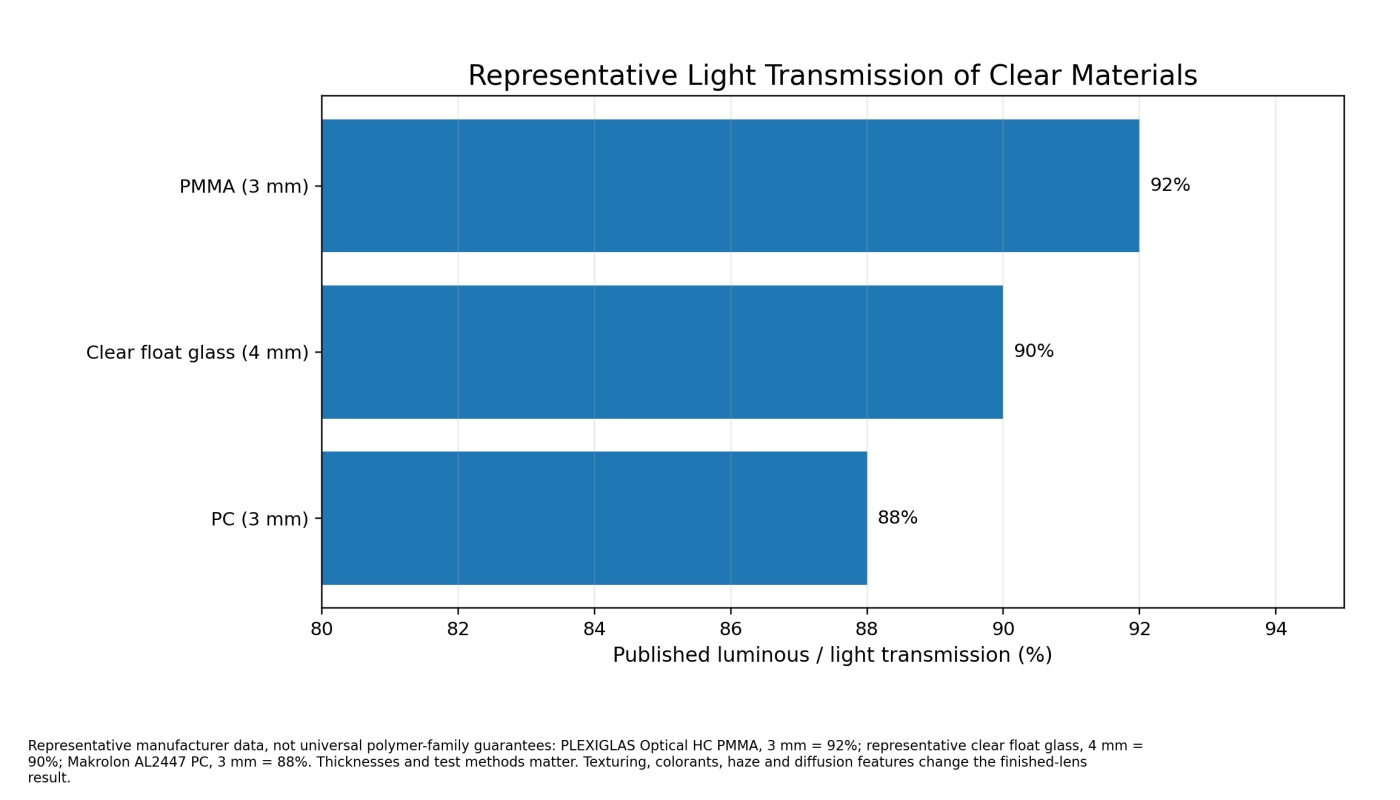
Figure 2. Published light-transmission values for representative clear materials.
Values are product- and thickness-specific: 3 mm PLEXIGLAS Optical HC PMMA 92%; representative 4 mm clear float glass 90%; 3 mm Makrolon AL2447 PC 88%. Sources: [7-8].
For a solar grave light, the highest transmission value is not automatically the best optical result. A flame-effect LED may require controlled diffusion, surface texture or tinting to produce a more uniform and natural appearance. Buyers should therefore specify both a transmission target and an appearance reference sample, then verify the finished lens rather than relying only on raw-resin data.
Metal may perform structural, decorative and protective functions in a solar grave lantern. It may be used in frames, roofs, bases, handles, brackets, screws, decorative crosses and internal supports. The term “metal lantern” does not establish long-term corrosion performance.
For powder-coated steel, the buyer should specify the steel grade, sheet or wire thickness, degreasing method, surface preparation, conversion coating or primer, powder type, nominal dry-film thickness, curing conditions, edge and weld protection, permitted pinholes and bare areas, adhesion criteria, and color and gloss tolerance.
Powder coating alone does not guarantee corrosion resistance. Critical areas frequently include cut edges, punched holes, welds, threads, folded seams, drainage points, areas damaged during assembly and metal-to-metal contact points.
Stainless steel may support a premium product position, but “stainless steel” is not a complete specification. The project should define grade, sheet thickness, surface finish, brushing direction, weld quality, cleaning process, passivation requirements, contact with other metals and environmental exposure.
Different stainless grades can behave differently in the presence of chloride contamination, fertilizer, cleaning chemicals, stagnant water, dissimilar metals and fabrication contamination. [10]
Aluminum can reduce product weight and may be powder coated, anodized, polished or brushed. The specification should address the alloy, wall or sheet thickness, coating or anodizing requirements, color consistency, scratch resistance, isolation from steel or other dissimilar metals, galvanic-corrosion risk and treatment of cut and drilled areas. [9]
ISO 9227:2022 describes neutral salt spray, acetic acid salt spray and copper-accelerated acetic acid salt spray methods. The standard does not automatically define the required exposure time for a particular product, specimen dimensions, acceptance criteria or the service life represented by a result. It is particularly useful for identifying discontinuities, pores and defects in protective systems. [11]
Do not make an unsupported life conversion
“The product passed 500 hours of salt spray, so it will last five years outdoors” is not a professionally justified conclusion without a validated correlation for the specific substrate, coating, test configuration and environment.
A meaningful corrosion requirement should identify the substrate, pretreatment, coating system, test method, test duration, whether the sample is scribed, evaluation points, permitted red rust, permitted white corrosion, blistering and delamination criteria, and any required post-test functional check.
Decorative resin or polyresin is particularly useful for angels, crosses, religious figures, memorial sculptures, relief patterns, stone effects, irregular shapes and highly detailed ornamentation. Its main advantage is the ability to reproduce complex forms. Its main sourcing risk is the broad and imprecise use of the word “resin”.
A resin product may involve different polymer chemistries, fillers, filler ratios, pigments, curing agents, mixing ratios, curing cycles, protective primers and topcoats. It is therefore inaccurate to state that every resin product will inevitably fade or crack. Outdoor-capable polyurethane and composite resin systems exist with strong UV and weathering properties, demonstrating that performance depends on the specific material system rather than the generic name. [25]
base resin chemistry;
filler type and ratio;
pigment type and coloring method;
mixing controls;
curing time and temperature;
permitted air bubbles and voids;
minimum thickness in critical areas;
reinforcement where required;
primer and topcoat;
UV-protection strategy;
coating adhesion;
color-change limits;
water-absorption evaluation;
temperature and freeze-thaw testing.
thin projecting fingers, wings, crosses or ornaments;
screw-fixing areas;
flat surfaces where water can remain;
resin-to-metal joints;
resin around the solar-module opening;
sharp changes in wall thickness;
poorly cured internal areas;
incomplete coating coverage in recesses.
A visually acceptable new sample does not automatically demonstrate long-term outdoor durability.
Many well-developed solar grave lights use several materials rather than one. A typical product may combine a coated metal frame, glass or PMMA side panels, an ASA or ABS top cover, a PC transparent element, an elastomer gasket, a plastic battery compartment, stainless or plated steel screws and adhesive around the solar panel.
A hybrid structure can combine appearance, impact resistance, low weight, production efficiency, perceived value and cost control. However, the most likely failure location may be the interface between two materials rather than either material itself.
solar panel to top-cover joint;
glass to metal frame;
lens to plastic housing;
gasket to battery cover;
switch opening;
wire entry;
screw and body made from dissimilar metals;
adhesive exposed to UV and moisture;
components with different thermal expansion;
horizontal joints that retain water;
battery doors opened and closed repeatedly.
dimensional tolerances and assembly clearance;
adhesive type, application quantity and surface preparation;
gasket material, hardness and compression;
screw material and tightening torque;
thread protection;
drainage and condensation path;
reassembly and resealing requirements.
A hybrid product can deliver the strongest commercial balance, but only when the joints are engineered and tested as carefully as the visible materials.
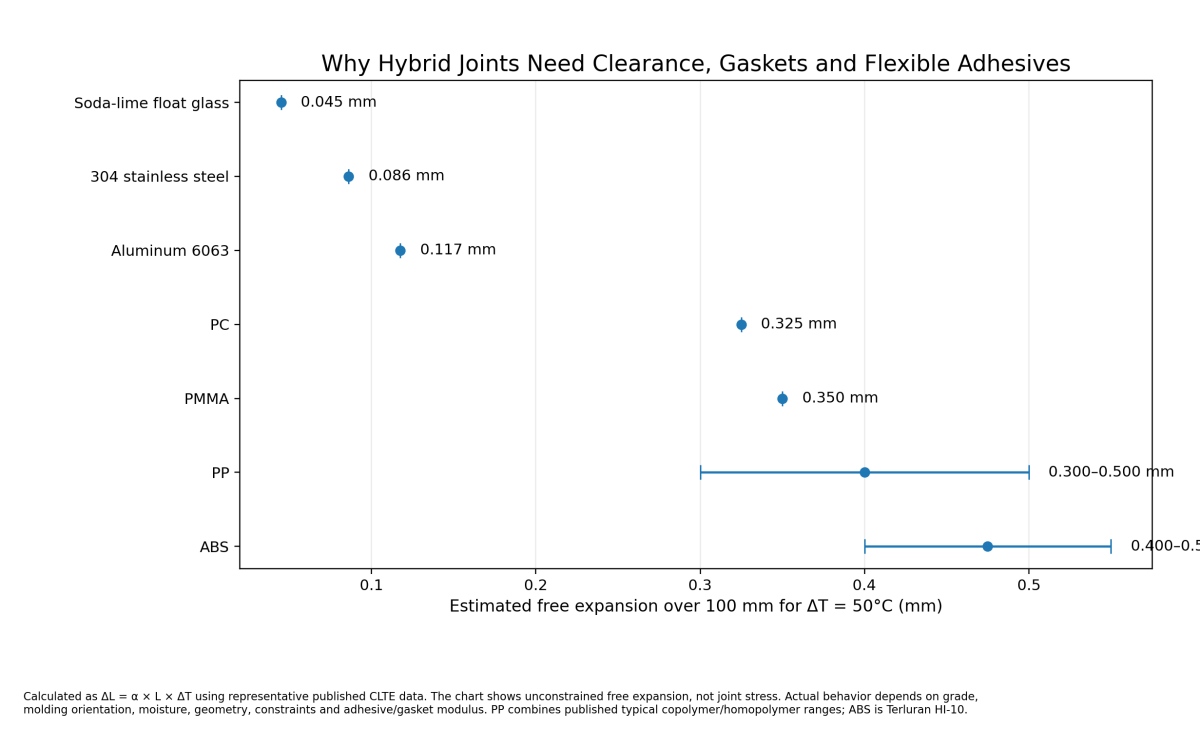
Figure 3. Estimated free expansion over a 100 mm length for a 50°C temperature change.
Method: ΔL = α × L × ΔT using representative published coefficients of linear thermal expansion. This is a preliminary engineering calculation, not a leakage or service-life prediction. Sources: [5-10].
This calculation is especially relevant around solar-panel frames, battery doors, transparent lenses and glass-to-metal interfaces. It supports the use of realistic assembly clearance, controlled gasket compression and adhesives with appropriate flexibility. The figure shows unconstrained movement; it does not predict actual joint stress, which also depends on geometry, orientation, moisture, constraint and the mechanical behavior of the sealing system.
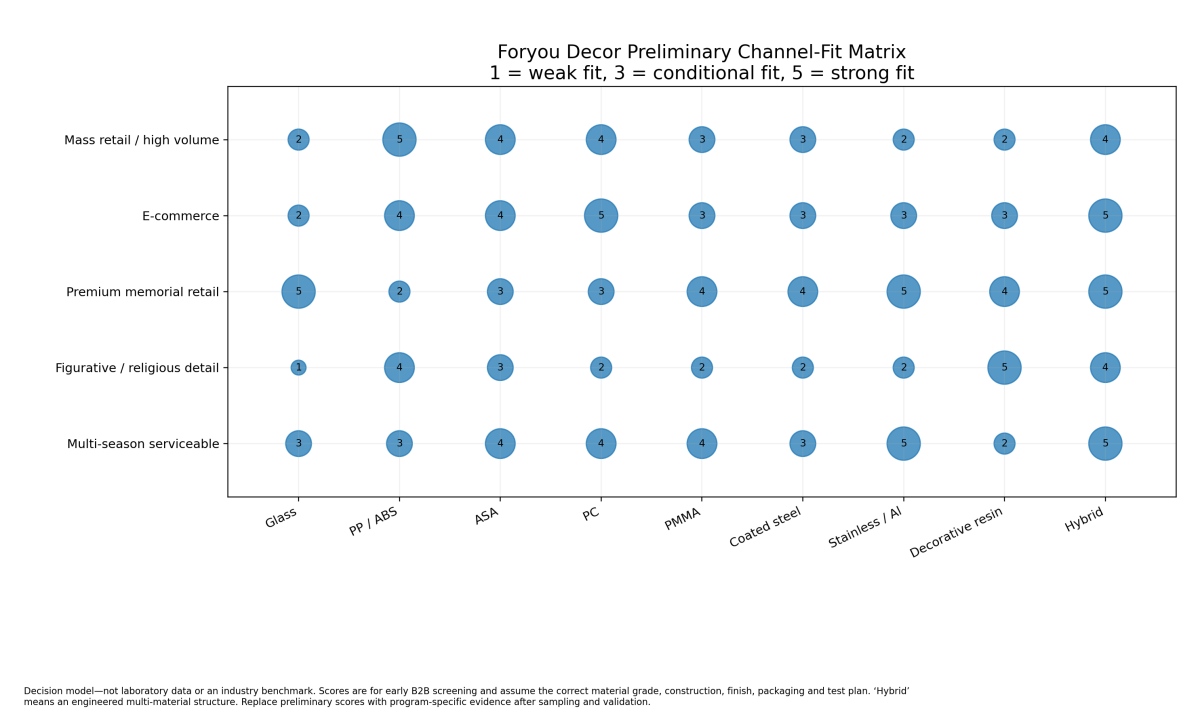
Figure 4. Foryou Decor preliminary channel-fit matrix.
Foryou Decor decision model: 1 = weak fit, 3 = conditional fit, 5 = strong fit. Not an industry benchmark or laboratory data.
The matrix is a structured screening tool rather than laboratory data. A score of 5 means a material direction is often a strong starting point for that channel, not that it will automatically pass testing or provide the lowest total cost. Each score assumes an appropriate material grade, structure, finish, packaging and quality-control plan. Replace the preliminary score with model-specific evidence after samples and tests are completed.
A typical direction may include a lightweight PP, ABS or ASA body, a PC or PMMA transparent part, a low part count, efficient assembly, packaging optimized for pallet and container loading, controlled color consistency and simple functional testing.
Typical priorities include unit cost, molding efficiency, output capacity, pieces per master carton, container utilization, damage rate, retail-display efficiency and rapid inspection. A small increase in unit material cost may be justified when it significantly reduces assembly defects, breakage or customer returns.
In e-commerce, the cost of a damaged item can include the replacement product, outbound shipping, return shipping, customer-service labor, refund processing, loss of margin, negative reviews and disposal of the damaged item. Material and packaging should therefore be developed as a single system.
PC may be advantageous where transparent-part impact is the primary risk. Glass can still be used, but it may require larger protective clearances, molded-pulp or foam supports, corner protection, separation from metal components, more robust master cartons and validated drop and vibration testing.
A common direction for premium solar cemetery lanterns is glass, carefully finished metal, minimal visibility of basic plastic components, controlled fit between parts, a replaceable battery or solar module and packaging that protects decorative surfaces.
In this segment, buyers may evaluate proportions, weight and visual substance, edge finish, coating uniformity, alignment, light distribution, color temperature, memorial details and ease of opening the battery compartment. Perceived value depends on the complete product, not merely the nominal material.
For angels, crosses, saints, reliefs and sculptural memorial forms, decorative resin may be the most practical production route. Development should include verification of pigment durability, topcoat performance, thin-feature strength, water retention, low-temperature cycling, the resin-to-solar-module connection and packaging support for projecting details.
For products intended to remain in use for more than one season, material selection should be connected to serviceability. Important considerations include a user-replaceable battery, accessible battery compartment, replacement solar module, repeatable gasket compression, durable screws, cleaning access for the solar panel, resistance to repeated opening, clear battery orientation, compatible spare parts and separation of electronics from housing materials at end of life.
Commercial implication
A product that can be maintained may deliver greater customer value than a permanently sealed product whose battery cannot be replaced.
The lowest-cost housing does not always create the lowest total sourcing cost. A more complete model is:
Total Program Cost
Product + Tooling + Packaging + Freight + Inspection + Compliance + Damage + Claims + Replacement Parts + End-of-Life Obligations
tooling investment;
economic minimum order quantity;
unit weight;
carton and container utilization;
protective inserts;
glass-breakage percentage
surface-scratch rejection;
coating repair;
additional visual inspection;
laboratory testing;
compliance-document preparation;
national producer registration;
returns and replacements;
spare-part inventory;
waste and recycling obligations.
A heavier glass-and-metal product may support a higher retail price, but it may also increase freight cost, packaging volume, breakage exposure, manual handling and replacement cost. A lightweight plastic product may appear economical, but an unsuitable grade or weak joint design can increase fading complaints, cracking, water ingress, warranty claims and customer dissatisfaction.
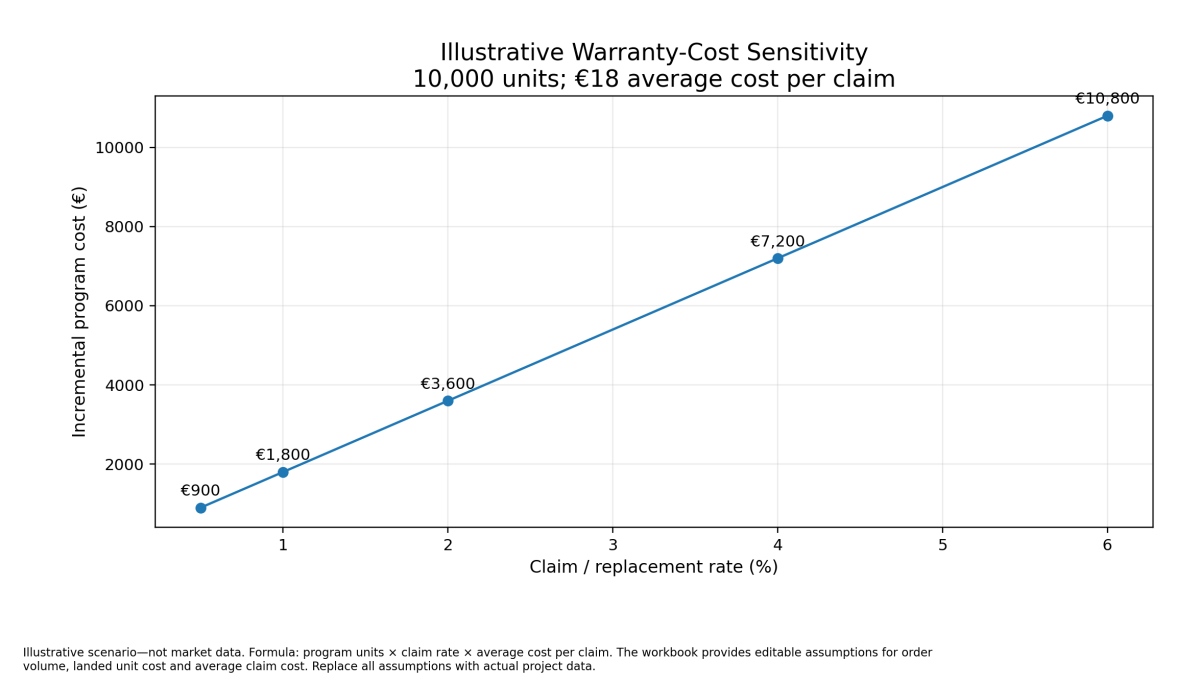
Figure 7. Illustrative effect of claim rate on program cost.
Illustrative scenario: 10,000 units and €18 average cost per claim. Formula: program units × claim rate × average cost per claim. Replace all assumptions with actual project data.
This is an editable sensitivity example, not a market benchmark. It shows why a small unit-cost saving may be uneconomic when it creates additional breakage, water-ingress or battery claims. Buyers should replace the example assumptions with their actual replacement product cost, freight, handling, refund and customer-service data.
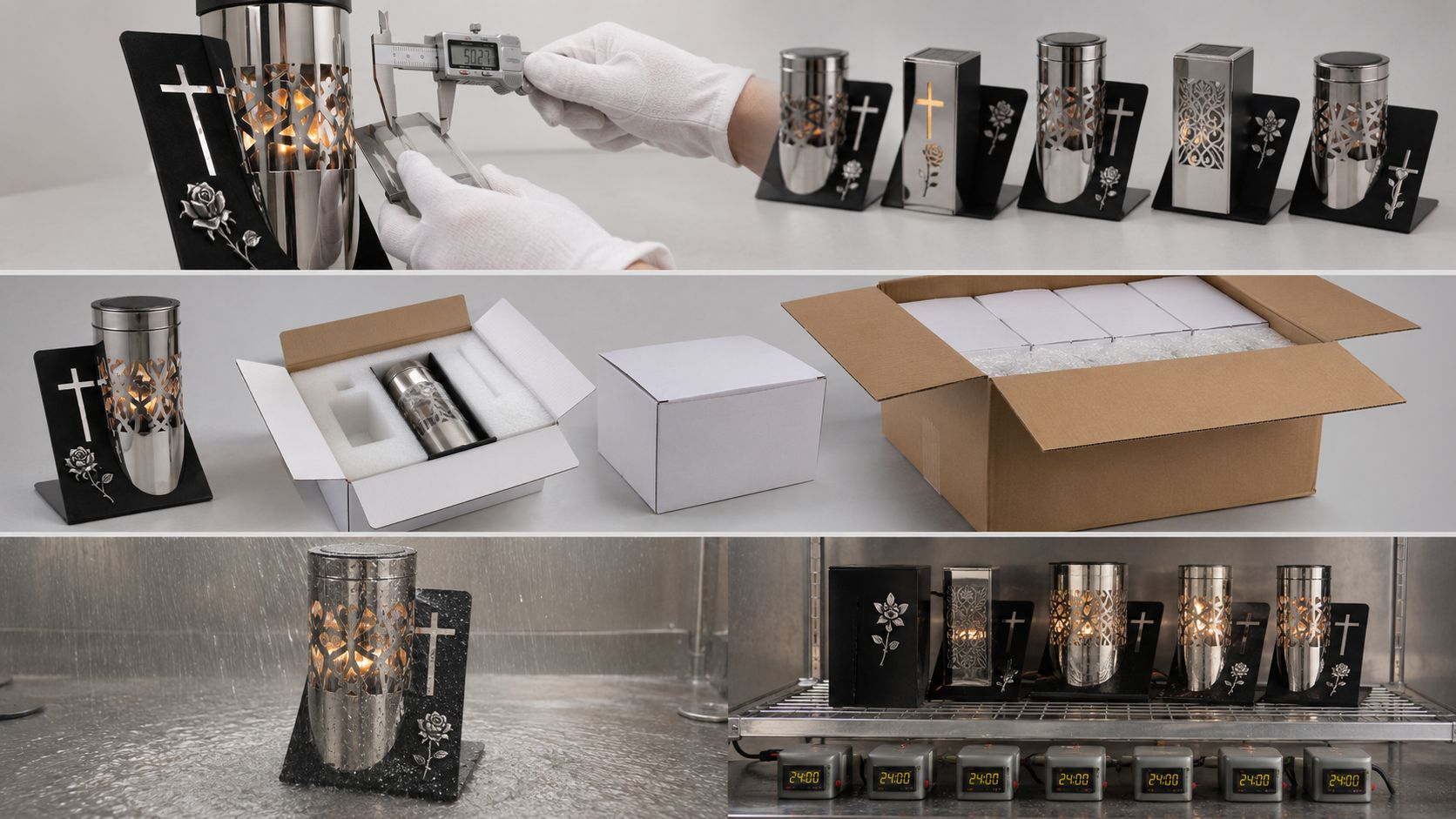
There is no single universal test package for all solar grave lights. The test plan should be based on product classification, materials, electrical design, battery chemistry, target market, intended outdoor environment, sales channel, product claims, expected service life and identified failure modes.
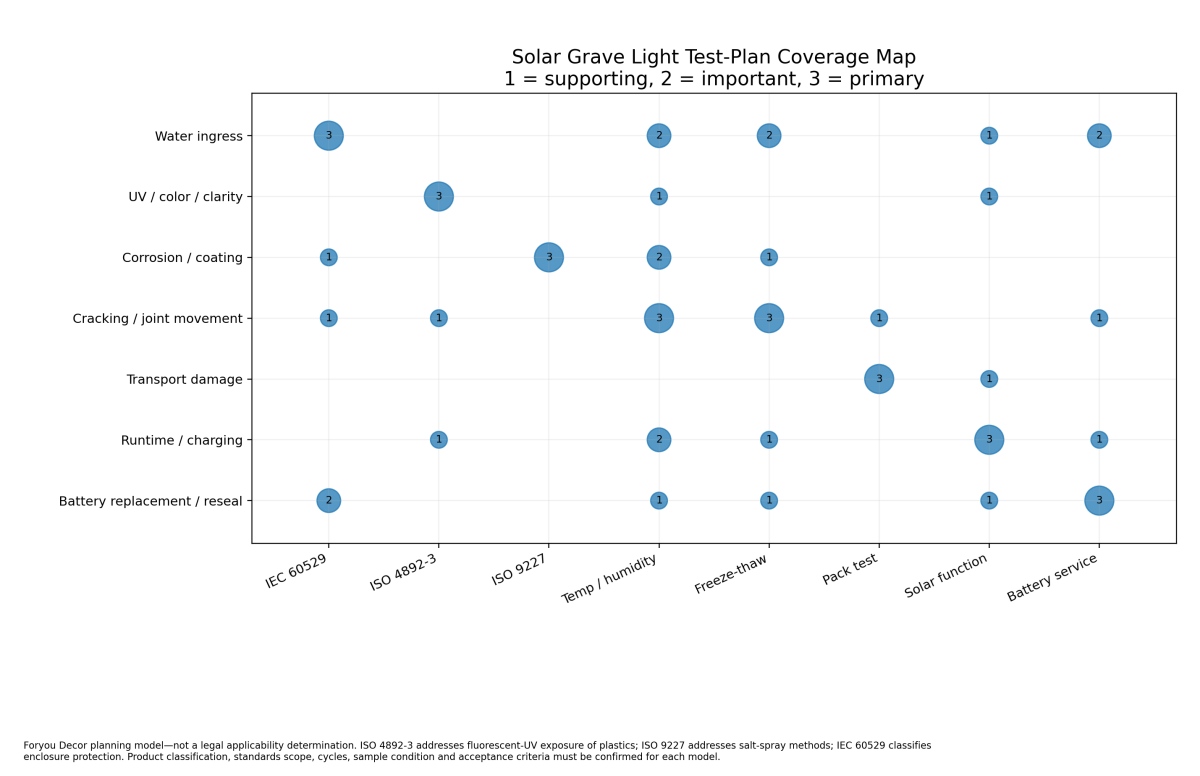
Figure 5. Test-plan coverage map for common solar grave light failure modes.
Foryou Decor planning model: 1 = supporting, 2 = important, 3 = primary. Standards do not automatically define model-specific samples, cycles or pass/fail criteria.
No single test demonstrates total outdoor durability. An IP test does not establish UV resistance, while salt spray does not validate transport performance or battery replacement. A professional validation plan therefore links each identified failure mode to an appropriate test, sample condition and acceptance criterion. Product classification and standards applicability should be confirmed by a competent laboratory or compliance specialist.
Area | Possible technical basis | What must be defined before testing |
Enclosure protection | IEC 60529 | Target IP code, product position, sample condition and post-test function |
Luminaire safety | Applicable parts of IEC/EN 60598 | Product classification, electrical construction and applicable scope |
Plastic weathering | ISO 4892-3 or agreed method | Lamp type, cycle, time, temperature, water exposure and acceptance criteria |
Metal corrosion | ISO 9227 | Method, duration, sample preparation and evaluation criteria |
Temperature and humidity | Agreed product procedure or applicable standard | Temperature range, dwell time, humidity and number of cycles |
Freeze-thaw performance | Market-specific agreed procedure | Moisture condition, temperatures, cycles and acceptance criteria |
Transport performance | Finished-pack protocol | Drop height, orientation, vibration, stacking and sample quantity |
Solar function | Model-specific procedure | Charging conditions, temperature, irradiance and runtime measurement |
Battery compartment | Functional and environmental cycling | Leakage, corrosion, replacement and repeated resealing |
Production inspection | AQL or agreed sampling plan | Critical, major and minor defect definitions |
IEC 60529 classifies the degree of protection provided by an enclosure against access, solid objects and water. It does not automatically evaluate UV resistance, corrosion, coating durability, battery life, low-temperature performance, transport resistance, solar-panel aging, adhesive durability or total product service life. [13]
A claim such as “waterproof” is too broad unless it is connected to a defined IP code, specified product configuration, test report and clear pass/fail result.
A single IP requirement should not be assigned to every solar grave light without first determining the product’s technical classification. IEC 60598-2-4:2017 applies to portable general-purpose luminaires for indoor or outdoor use and identifies IPX4 as the minimum water-protection level for outdoor portable luminaires within its scope. That does not automatically prove that every solar grave light falls within this exact classification. [14]
IEC 60598-1:2024 establishes general safety requirements for luminaires and should be considered together with the appropriate product-specific part where applicable. A competent laboratory or compliance specialist should confirm classification, applicable standards, IP level, marking, instructions and electrical, mechanical and thermal tests. [15]
ISO 4892-3:2024 describes laboratory exposure of plastic specimens to fluorescent UV radiation, heat and water. Possible evaluation criteria include color difference, gloss retention, yellowing, cracking, chalking, transparency change, impact-strength retention and dimensional stability. [12]
The test requirement must define more than the number of hours. It should identify the lamp type, irradiance, cycle, black-panel or chamber temperature, condensation or water-spray conditions, specimen preparation, measurement method and acceptance limits.
Avoid unsupported acceleration claims
A statement such as “1,000 hours of UV testing equals five years outdoors” should not be used without a defensible correlation for the specific material, exposure cycle, climate and property being evaluated.
Transport verification should be performed on the finished retail and master-carton packaging. Depending on the distribution route, the protocol may include drop testing, random or fixed-displacement vibration, compression, stacking, handling simulation, temperature and humidity conditioning and post-test functional checks.
Acceptance criteria should cover broken glass, cracks, loosened components, surface scratches, deformation, LED function, solar charging, switch operation, packaging collapse, and barcode and label legibility.
A solar grave light containing a solar panel, rechargeable battery, LED and electronic circuit should not be evaluated only as a glass, metal, plastic or resin decoration. Its regulatory assessment may involve general product safety, electrical and electronic equipment, restricted substances, waste electrical equipment, batteries, electromagnetic compatibility, product traceability, packaging and producer responsibility.
The exact legal scope depends on construction, voltage, circuit design, battery chemistry, functionality, market, importer and manufacturer roles, and whether the product is sold under a private label. The following section is a sourcing overview, not a substitute for product-specific legal assessment.
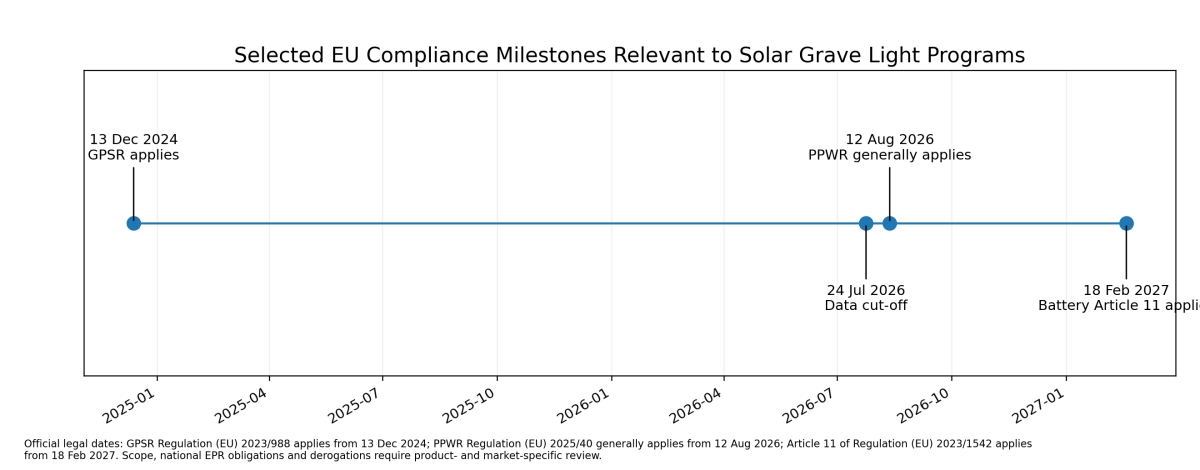
Figure 6. Selected EU compliance milestones relevant to solar grave light programs.
Official legal dates: GPSR applies from 13 December 2024; PPWR generally applies from 12 August 2026; Batteries Regulation Article 11 applies from 18 February 2027, subject to scope and derogations. Sources: [16], [19], [24].
The timeline should be treated as a project-planning trigger rather than a complete legal checklist. Buyers must still determine product classification, applicable CE legislation, national WEEE and packaging EPR obligations, battery chemistry requirements, labeling, language and responsible-person duties for each destination market.
Regulation (EU) 2023/988, the General Product Safety Regulation, has applied since 13 December 2024. It strengthens requirements for non-food consumer products sold online and offline, including responsibilities across the supply chain and rules relevant to direct imports. [16]
For a solar grave light program, the product file may need to address product identification, foreseeable use and misuse, risk assessment, manufacturer information, EU responsible-person information where applicable, batch or serial traceability, warnings and instructions, online-listing information, and complaint and incident handling.
The RoHS framework restricts specified hazardous substances in electrical and electronic equipment. A documentation package may include supplier material declarations, component declarations, bill-of-material traceability, test reports where necessary, solder information, wire and cable documentation, plastic and pigment declarations, coating information and review of any applicable exemptions. [17]
A generic “RoHS compliant” statement is more credible when supported by a controlled component and material file.
The WEEE Directive requires separate collection and appropriate treatment of waste electrical and electronic equipment and establishes collection, recovery and recycling objectives. The company placing the product on a national EU market should assess producer registration, reporting, financing obligations, crossed-out wheeled-bin marking, local authorized-representative requirements, collection and recycling responsibilities and country-specific EPR rules. [18]
Article 11 of Regulation (EU) 2023/1542 applies from 18 February 2027 and contains requirements concerning the removability and replaceability of portable batteries and light-means-of-transport batteries. As a general rule, portable batteries incorporated into products must be removable and replaceable by the end user, subject to the Regulation’s conditions and derogations. Product-specific classification remains necessary. [19]
For a solar grave light, the design team should consider how the battery compartment is opened, whether commercially available tools are needed, whether the product is damaged during removal, battery polarity protection, compatible replacements, resealing after replacement, instructions, battery chemistry and labeling, and availability of replacement parts.
Important
Outdoor use does not, by itself, prove that a product is exempt from battery-removability requirements.
CE marking is not a general quality certificate or an automatic EU authority approval. Where applicable, the manufacturer is responsible for identifying relevant EU harmonization legislation, completing the conformity assessment, preparing the technical file, issuing the EU Declaration of Conformity and applying the CE mark correctly. [20]
Not every product requires CE marking. Conversely, a product containing electrical or electronic functions may fall under more than one applicable act. For a specific solar grave light, the review may need to consider RoHS, electromagnetic compatibility, applicable luminaire requirements, electrical safety, radio-equipment rules if wireless functions are included and other product-specific legislation.
The Low Voltage Directive covers electrical equipment designed for use with a voltage rating between 50 and 1,000 V AC and between 75 and 1,500 V DC. A typical small solar grave light may be below those ranges, but that does not remove other legal obligations. The application of the EMC Directive depends on the actual electronic circuit and product behavior. [21-22]
When a product contains a lithium-metal or lithium-ion battery, the buyer should verify the transport documentation and testing applicable to the battery and shipment configuration. UN Manual of Tests and Criteria subsection 38.3 sets testing requirements for lithium cells and batteries. [23]
The procurement file may need to include the battery manufacturer and model, cell and pack specification, UN 38.3 test summary, safety information where applicable, packing configuration, transport mode, state-of-charge restrictions where applicable, and labeling and documentation requirements. UN 38.3 should not be requested automatically for every rechargeable-battery chemistry; Ni-MH and other non-lithium systems have different transport considerations.
Regulation (EU) 2025/40 on packaging and packaging waste entered into force on 11 February 2025 and generally applies from 12 August 2026. It covers packaging regardless of material and establishes requirements concerning composition, design, waste prevention and recoverability. [24]
For solar grave light importers, this increases the importance of reducing unnecessary packaging, minimizing empty space, selecting recyclable material combinations, documenting packaging composition, controlling packaging weight, avoiding problematic substances, assessing recoverable design and meeting national EPR requirements. Packaging still has to protect the product; material reduction should not create a higher damage rate that results in more product waste.
An incomplete request might read: “Please quote a metal solar grave light with a plastic lens.” That description does not provide enough information for controlled costing, engineering, compliance or quality assurance.
A professional RFQ should cover the following areas.
Target country or countries.
Sales channel.
Target retail price.
Estimated order volume.
Economy, mid-market or premium positioning.
Intended product life.
Seasonal launch date.
Required delivery window.
Online and retail product claims.
Exact polymer family and preferred grade.
UV-stabilization requirements.
Permitted recycled-content percentage.
Minimum plastic wall thickness.
Glass type and thickness.
Glass-edge treatment.
Metal grade and thickness.
Surface pretreatment.
Coating type and thickness.
Resin chemistry and filler requirements.
Pigment and topcoat requirements.
Solar-panel type.
Nominal panel voltage and power.
LED type.
Light color or color-temperature target.
Battery chemistry.
Nominal battery capacity.
Battery supplier and model.
Battery-compartment construction.
Battery-replacement method.
Runtime test conditions.
Target enclosure-protection level.
Gasket material and design.
Solar-panel mounting method.
Drainage design.
Joint tolerances.
Fastener material.
Screw torque.
Serviceability requirements.
Replacement-module requirements.
Laboratory test scope.
Sample quantity.
Test configuration.
Acceptance criteria.
AQL sampling plan.
Critical, major and minor defect definitions.
Approved reference sample.
Production color standard.
Lot-traceability requirements.
Reinspection procedure.
Material specifications.
Component declarations.
RoHS documentation.
Battery documentation.
Lithium-battery transport documents where applicable.
GPSR risk information.
WEEE information.
Applicable conformity documentation
Instructions and warnings.
Required languages.
Batch and importer labeling.
Individual packaging format.
Protective insert material.
Master-carton dimensions.
Net and gross weight.
Pieces per carton.
Pallet and container loading.
Transport-test protocol.
Barcode and label requirements.
Packaging-material declaration.
EPR-related information.
At Foryou Decor, we do not begin a development project by automatically recommending one “best” material. The first step is to define the target market, intended retail channel, price positioning, order volume, product architecture, visual target, service-life expectation, packaging route, inspection standard and documentation requirements.
A structured project can then follow this sequence:
1. Market and functional brief
2. Initial material and component BOM
3. Total-cost review
4. Structural prototype
5. Material-grade confirmation
6. Approved reference sample
7. Test plan and acceptance criteria
8. Packaging validation
9. Pre-production sample
10. In-process quality monitoring
11. Final random inspection
12. Shipment release and follow-up
Foryou Decor’s published B2B services include bulk production, OEM and ODM support, customization of size, color, finish, structure, logo and packaging, together with quality inspection before shipment. Its quality workflow also describes pre-production confirmation, process monitoring, AQL-based final inspection and shipment follow-up. The exact test program, documentation scope and acceptance criteria should still be agreed for each model and destination market. [1-2]
There is no single best material for every solar grave light. The following recommendations should be used as controlled starting points rather than universal rules.
Material direction | Choose it when | Do not omit |
Glass | Traditional appearance and premium positioning are essential | Control edges, mounting clearance, frame geometry and finished-pack breakage |
PP | A lightweight and economical molded body is required for high volume | Specify the grade, UV package, wall thickness and recycled-content controls |
ABS | High surface quality, painting or metallic effects are important | Validate the complete outdoor coating and aging system |
ASA | A colored exterior housing needs better documented weatherability | Use a defined outdoor grade and post-aging acceptance criteria |
PC | Impact resistance is the primary transparent-part risk | Specify UV stability, stress control, chemical compatibility and surface expectations |
PMMA | Optical appearance and long-term outdoor clarity are priorities | Manage impact risk through geometry, assembly and packaging |
Metal | Rigidity and perceived value are important | Define the alloy, pretreatment, coating and corrosion-critical details |
Decorative resin | The product requires complex figures or reliefs | Define resin chemistry, filler, pigment, coating and environmental tests |
Hybrid construction | The best balance of aesthetics, cost, weight and performance is required | Engineer and validate every interface, seal, adhesive, drainage path and fastener |
The professional decision standard
A precise specification, a robust construction, an approved reference sample, a defined test plan and controlled mass production.
Which solar grave light material is the most durable?
There is no reliable answer without identifying the exact grade, structure, coating, environment and weak points of the complete product. A properly coated metal structure, an outdoor-grade polymer or a well-designed glass-and-metal lantern may all provide good durability. The earliest failure may still occur in the battery, solar panel, electronics, adhesive or seal.
No. PC is commonly selected for higher impact resistance. PMMA is commonly selected for optical clarity and weathering performance. The correct choice depends on grade, thickness, geometry, assembly, surface protection, target environment, packaging and test results.
No. IP65 describes a defined degree of enclosure protection against dust and water. It does not establish battery life, UV durability, corrosion resistance, freeze-thaw performance, solar-panel life, adhesive durability, transport resistance or overall service life.
No. ISO 9227 does not provide a universal conversion between laboratory exposure hours and real outdoor service life. Test duration, sample preparation, coating system, environment and acceptance criteria must be defined for the product.
This cannot be decided from the product name alone. CE marking is required only where applicable EU harmonization legislation requires it. A solar light with electronic components may fall within the scope of RoHS, EMC or other legislation, but the assessment must be completed for the specific design.
Depending on the product and destination market, the package may include a product specification, bill of materials, material declarations, RoHS documentation, battery specification and test documents, risk assessment, WEEE information, finished-product reports, instructions and warnings, traceability records, an EU Declaration of Conformity where required and lithium-battery transport documents where applicable.
For products placed on the EU market, battery removability and replaceability should be reviewed during design. Article 11 of Regulation (EU) 2023/1542 applies from 18 February 2027. The general rule and any relevant derogation must be assessed for the specific product. A serviceable battery compartment may also improve product life and customer value independently of the legal assessment.
Data and methodology
Material-property figures in this article are representative values taken from published technical data for specific commercial grades or products. They are not guaranteed values for every material within the same polymer, glass or metal family. Decision matrices and cost scenarios are Foryou Decor planning tools rather than industry-wide statistics. Final product selection should be based on the approved BOM, supplier technical data sheets, finished-product testing and destination-market compliance review.
Figure | Content | Evidence type |
1 | Equal-volume material mass | Published technical values for representative grades or materials |
2 | Representative clear-material light transmission | Published product- and thickness-specific data |
3 | Hybrid-joint thermal expansion | Engineering calculation using published representative CLTE data |
4 | Sales-channel fit matrix | Foryou Decor preliminary decision model |
5 | Test-plan coverage map | Foryou Decor planning model informed by the scopes of referenced standards |
6 | Selected EU compliance timeline | Official legal application dates |
7 | Claim-cost sensitivity | Illustrative editable commercial scenario |
Do not publish unsupported performance claims such as IP65, three-to-five-year service life, 1,000-hour UV resistance, 500-hour salt-spray resistance, all-night runtime or operation at a specified sub-zero temperature unless a report or documented validation exists for the exact model and test conditions.
Keep thickness, material grade and test-condition qualifiers attached to technical values.
Do not describe the channel-fit, test-coverage or cost-sensitivity figures as industry statistics.
Do not use the thermal-expansion calculation as a direct prediction of leakage or service life.
Re-check regulatory wording and application dates before publication or reuse.
For a customer-specific article, replace representative values with the final approved BOM, technical data sheets and product reports.
This guide provides general B2B sourcing and product-development information. Applicable standards and legal requirements depend on the product’s final construction, electrical design, battery type, intended use, claims and destination market. Product-specific compliance should be confirmed with a qualified laboratory or regulatory specialist before placing the product on the market.
[1] Foryou Decor — Company Profile
[2] Foryou Decor — Grave Lantern Manufacturer for Cemetery and Memorial Decoration
[3] SABIC — LEXAN Polycarbonate Resin
[5] LyondellBasell — A Guide to Polypropylene Film Extrusion
[6] INEOS Styrolution — Terluran HI-10 ABS Product Data
[7] Röhm PLEXIGLAS — PMMA Product and Technical Information
[8] Covestro — Makrolon Optical and General-Purpose Polycarbonate Data
[9] Hydro — EN AW-6063 Aluminum Alloy Data Sheet
[10] thyssenkrupp Materials — Stainless Steel 304 / 1.4301
[11] ISO 9227:2022 — Corrosion Tests in Artificial Atmospheres — Salt Spray Tests
[12] ISO 4892-3:2024 — Plastics — Methods of Exposure to Laboratory Light Sources — Fluorescent UV Lamps
[13] IEC 60529 — Degrees of Protection Provided by Enclosures (IP Code)
[14] IEC 60598-2-4:2017 — Portable General-Purpose Luminaires
[15] IEC 60598-1:2024 — Luminaires — General Requirements and Tests
[16] EUR-Lex — Regulation (EU) 2023/988 on General Product Safety
[17] European Commission — RoHS Directive
[18] European Commission — Waste Electrical and Electronic Equipment (WEEE)
[19] EUR-Lex — Regulation (EU) 2023/1542 Concerning Batteries and Waste Batteries
[20] European Commission — CE Marking
[21] European Commission — Low Voltage Directive
[22] European Commission — Electromagnetic Compatibility Directive
[23] UNECE — UN Manual of Tests and Criteria, Subsection 38.3 for Lithium Cells and Batteries
[24] EUR-Lex — Regulation (EU) 2025/40 on Packaging and Packaging Waste
[25] Covestro — Outdoor-Capable Thermoset and Polyurethane Systems


 English
 français
 Deutsch
 italiano
 русский
 العربية
 Türkçe
 čeština
 dansk
dansk Suomi
Suomi Polska
 magyar
 Svenska
 norsk
norsk română
 slovenský