Editorial standard: Official facts, observed retail examples and engineering recommendations are identified separately. The article does not convert demographic data into product demand and does not present a small retail sample as a national market average.
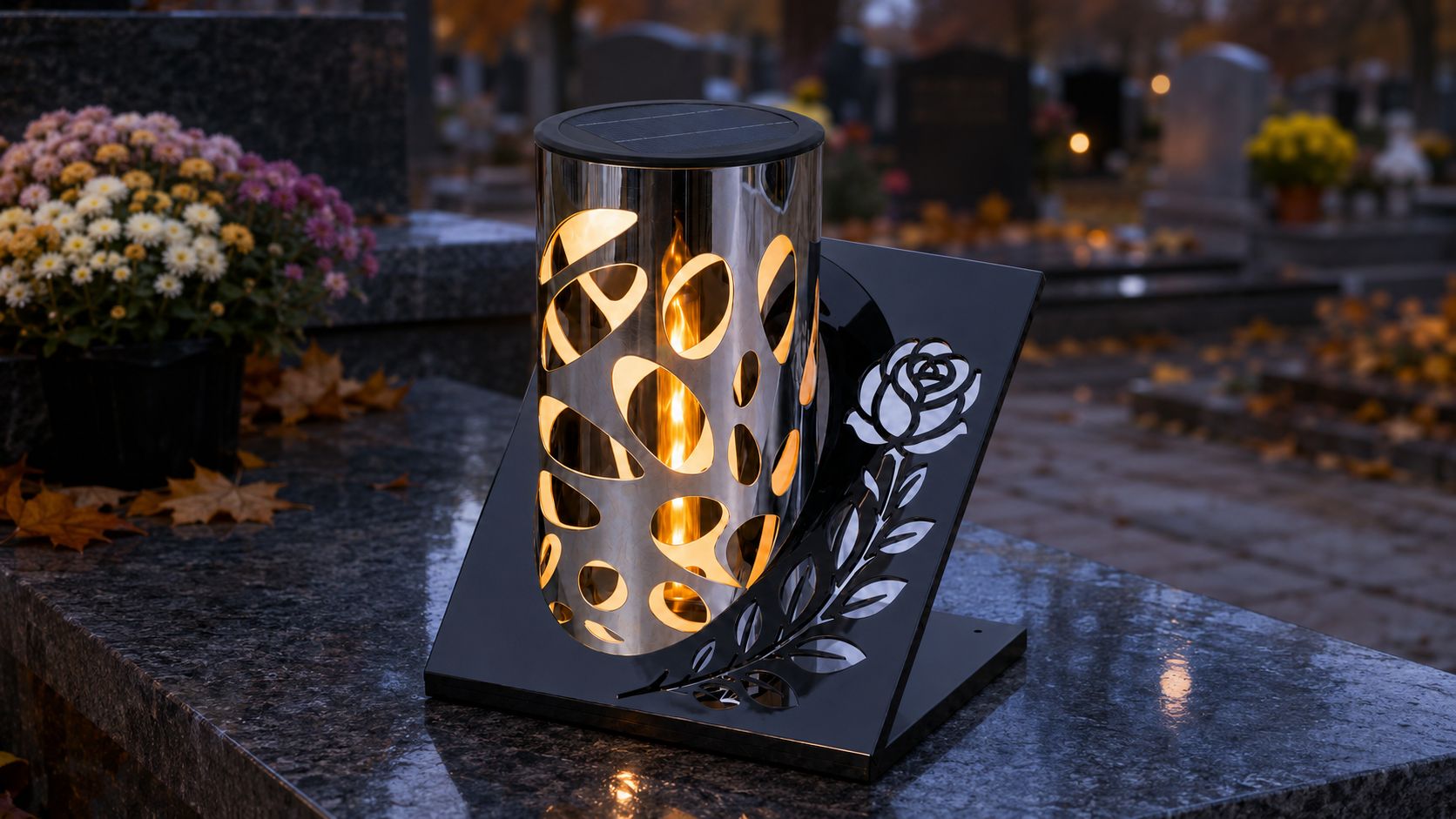
BUYER GUIDE | POLAND MARKET
A practical guide to winter energy, material disclosure, moisture control, serviceability and EU compliance
By Foryou Decor | 31 July 2026
Our position: the decisive specification for a Polish solar grave lantern is the winter energy budget—not the height of the lantern, the nominal battery capacity or the diameter of the solar top. A credible bulk order should define measured panel output, actual LED power, battery energy in watt-hours, the runtime test conditions, component-level materials, moisture-control details, serviceability, packaging acceptance criteria and the applicable EU compliance file before production begins.
Buyer Question | Minimum Acceptable Answer | High-Risk Answer |
1. What is promised? | Define summer and winter lighting claims separately, including hours, brightness profile and charge conditions. | “All night” or “year-round” with no test method. |
2. What does the panel deliver? | Require rated power or an agreed controlled-light output test plus active-area dimensions. | Diameter, voltage or “high efficiency” used as the only solar specification. |
3. What does the LED consume? | Measure electrical power and nightly watt-hour demand, including control-circuit losses. | LED type stated without current, voltage or power. |
4. Can the battery be serviced? | Specify chemistry, nominal and tested usable Wh, temperature limits and replacement method. | mAh alone, unknown cell brand or permanently inaccessible battery. |
5. What is actually stainless? | Use a component map for body, base, ornaments, fasteners and coating system. | One blanket “stainless steel” claim for mixed-material construction. |
6. How is moisture managed? | Set an IP target for the electronics and separately define drainage, venting and condensation checks. | IP language used as proof that internal condensation cannot occur. |
7. Who owns compliance? | Name the finished model, EU economic operator, label artwork, test evidence and technical-file owner. | Generic certificates for components or unrelated models. |
Three evidence types are used, and they should not be treated as interchangeable:
• Verified facts — official Polish statistics, official descriptions of Polish memorial tradition, JRC PVGIS irradiation data and published EU legislation.
• Observed market examples — a small, date-stamped group of Polish retail product pages used to illustrate visible assortment and price positioning. These are not sales data.
• Engineering recommendations — procurement starting points proposed for testing and negotiation. They are not statutory product standards and must be validated on the finished model.
Polish grave lanterns sit at the intersection of remembrance, cultural practice, seasonal retail and long-term outdoor exposure. Statistics Poland reported 37.3325 million residents at the end of 2025 and 405,700 deaths during 2025. The population aged 65 and over exceeded 7.9 million. These figures describe demographic context; they do not establish the annual demand, market share or sales volume of solar stainless steel grave lanterns.
Official demographic sources: Statistics Poland, Population and Vital Statistics 2025; Statistics Poland, regional socioeconomic situation 2025
The cultural evidence is more directly relevant to use. Poland’s Centre for the Development of Polish Education Abroad describes 1 November as a day when people visit cemeteries, tidy graves, decorate them with flowers and grave lights, and pray. The commercial implication is not that every visitor buys a solar lantern. It is that reliability, appearance and availability become especially visible during the autumn peak and the darker months that follow.
Cultural source: ORPEG, All Saints’ Day and All Souls’ Day in Polish tradition
A larger battery is useful as a short-term buffer, but it cannot correct a sustained energy deficit. If the lantern consumes more energy each night than the panel collects each day, the battery will eventually reach a low state of charge. Trees, monuments, dirt, snow, low sun angles and consecutive cloudy days can make the real deficit worse.
European Commission JRC PVGIS monthly data for Warsaw show average horizontal irradiation of about 175.5 kWh/m² in June and about 16.0 kWh/m² in December. The summer-to-winter difference is therefore roughly elevenfold. The important conclusion is not that one panel diameter always succeeds and another always fails; it is that winter performance must be calculated and tested as a complete system.
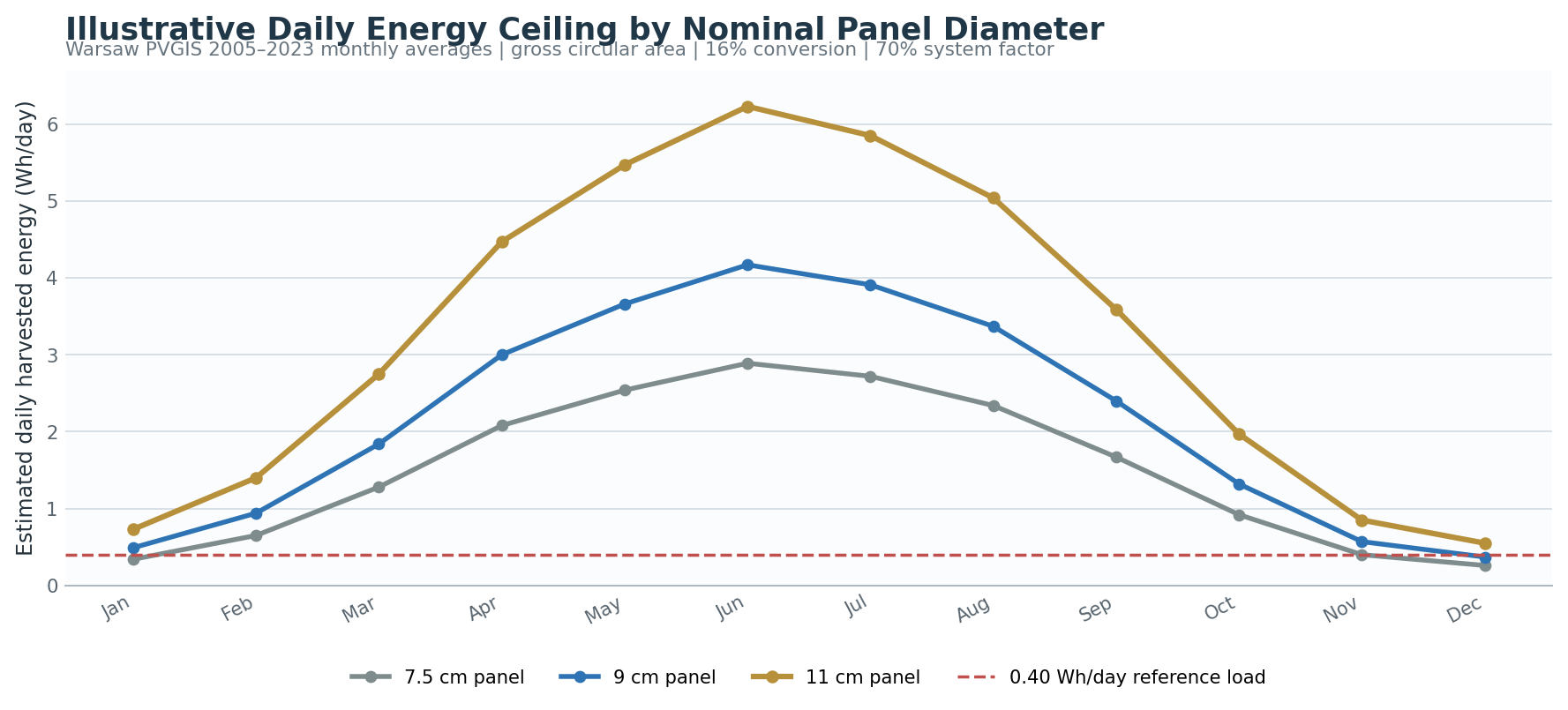
Figure 1. Illustrative energy ceiling based on Warsaw monthly irradiation; not a product-performance guarantee.
Source and assumptions: European Commission JRC PVGIS monthly radiation service; JRC PVGIS definition of monthly radiation
Nominal Diameter | Illustrative December Harvest | 8 h Load at 0.05 W | Illustrative Balance |
7.5 cm | 0.26 Wh/day | 0.40 Wh | −35% |
9 cm | 0.37 Wh/day | 0.40 Wh | −8% |
11 cm | 0.55 Wh/day | 0.40 Wh | +38% |
The calculation uses the full circular face as if it were active photovoltaic area, 16% conversion efficiency, a 70% system factor, a clean horizontal surface and no shade or snow. Real modules have frames and inactive regions, and finished-product losses vary. The numbers are therefore an illustrative upper envelope, not a supplier claim. Even the nominal 11 cm case should be validated against the actual module, electronics, temperature and location.
Procurement consequence: panel diameter is a packaging dimension, not an electrical rating. Require measured output under an agreed light condition, then compare harvested watt-hours with the complete nightly load. If winter input is insufficient, reduce the load, shorten or stage the lighting period, increase effective solar collection, or moderate the claim. Battery capacity alone is not the remedy.
Phrases such as “all night,” “up to 12 hours” or “year-round light” are incomplete unless the charge source, charge duration, starting battery state, LED power, temperature, brightness profile and end-of-test threshold are stated. Require two separate results: fully charged laboratory runtime and a defined winter recharge-and-discharge result. The second result is the more relevant retail claim for Poland.
Two modules with the same outer diameter can have different active areas, cell technologies, encapsulation losses and output. The purchase specification should record nominal diameter, active dimensions, rated or measured power, open-circuit voltage, short-circuit current and the test condition. Incoming inspection should include a controlled comparison with the approved golden sample.
A lantern can combine stainless sheet, plated steel, powder-coated steel, zinc alloy, aluminium, plastic and multiple fastener grades. Ask for a component-level material map and declared sheet thickness. A verified 304 visible shell is a defensible mainstream starting point; 430 may support a price-led range only when disclosed and validated for the intended exposure. Salt-exposed environments may justify evaluating 316, but grade alone cannot compensate for crevices, contamination or poor drainage.
An IP test addresses specified ingress conditions; it does not prove that a transparent chamber will remain condensation-free through temperature cycling. Define the IP target for the electronics compartment, then separately inspect panel seals, switches, cable passages, screw holes, drainage paths and pressure equalisation. The decorative chamber may need controlled ventilation even when the electronics are well protected.
IP reference: IEC explanation of ingress protection ratings
mAh is incomplete without voltage; compare batteries in watt-hours and confirm tested usable energy. The buyer should also obtain the cell manufacturer, chemistry, cycle and storage conditions, charge-temperature range and replacement method. Manufacturer documentation commonly limits charging to a defined temperature window, so a generic cell choice should not be assumed to charge correctly below 0°C.
Battery examples: Panasonic industrial NiMH catalogue; Murata rechargeable lithium-ion safety data
A visually premium lantern can be commercially weak if it scratches in transit, tips on polished granite or arrives with a cracked chamber. The specification should include net weight, base dimensions, anti-slip design, centre-of-gravity review, surface-protection film, glass separation and a defined carton-drop or distribution test. Post-test inspection must check scratches and loosening, not only catastrophic breakage.
Crosses, roses, angels, hearts, book plaques and personalised inscriptions are relevant visual languages, but every unique body creates tooling, packaging and seasonal inventory exposure. The lower-risk route is a small number of shared bodies with interchangeable front ornaments, plaques and finishes. Expand only after sell-through, return and search data justify the added complexity.
A certificate for a battery, LED, solar panel or similar lamp does not automatically cover the finished model. The technical file must match the actual bill of materials, circuitry, battery, housing, warnings, label, instructions and economic operator. Any material or electronic change after approval should trigger documented change control and, where relevant, re-evaluation.
The values below are engineering starting points for supplier discussion. They are not a universal legal standard and should be adjusted to the intended price tier, claim, battery chemistry, form factor and test plan.
Parameter | Recommended Requirement | Verification Method |
Solar module | Declare nominal size, active area and output under an agreed condition; use 11 cm-class or higher effective collection only as a structural starting point for winter-led ranges. | Output comparison to approved sample; record Voc, Isc and power where the method supports it. |
LED and controls | Warm white or amber flicker; target 0.03–0.05 W where winter runtime matters; define sensor thresholds and any staged dimming. | Measure voltage, current, power and eight-hour Wh consumption on the finished circuit. |
Battery | Replaceable battery with chemistry, nominal voltage, rated capacity, usable Wh, cell source and temperature limits. | Constant-current discharge in Wh plus charging test near the lower declared temperature. |
Material map | Declare grade, thickness and finish for visible shell, base, fasteners and ornaments; identify every non-stainless part. | Certificates plus risk-based XRF screening on first order and after approved material changes. |
Moisture control | Agree an IP target for electronics; define seals, drainage, venting and condensation acceptance separately. | IP test to the agreed IEC 60529 condition plus thermal-cycle and internal inspection. |
Parameter | Recommended Requirement | Verification Method |
Light chamber | Glass for premium appearance or UV-stabilised polycarbonate for impact-sensitive channels; define thickness and assembly gaps. | Material declaration, impact review, UV evidence where claimed and visual inspection after cycling. |
Serviceability | Battery and switch accessible without destroying seals or decorative parts; modular solar top preferred. | Timed open-replace-close trial followed by function and ingress checks. |
Stability | Base area, mass and anti-slip detail appropriate to polished stone and the selected height. | Incline or push test agreed with buyer; inspect after wind-relevant field trial. |
Packaging | Protect mirror surfaces, separate glass from metal contact and immobilise the lantern in the inner pack. | Transit simulation or agreed drop sequence; inspect glass, finish, fasteners and function. |
Traceability | Model, batch or date code, supplier BOM revision, label artwork and EU economic operator aligned. | Document audit against production sample and sealed reference file. |
Channel or Use Case | Recommended Range Architecture | Specification Priority |
E-commerce and wholesale volume | 23–26 cm shared body; restrained rose or cross variants; black/silver and black/gold. | Low-power LED, declared panel output, replaceable battery, protective finish film and conservative winter wording. |
Chain retail seasonal programme | 28–32 cm body with two core finishes and modular ornament system. | Stronger documented solar input, verified material map, repeatable packaging cube and batch traceability. |
Premium memorial or funeral channel | 32–38 cm body; angel, heart, book plaque or personalisation options. | Higher effective collection, serviceable module, premium chamber material, stable base and stronger transit protection. |
Winter-performance-led offer | Allow the energy budget to control the top geometry and lighting profile. | Measured panel output, LED at or below the agreed load, timed or staged brightness and a defined winter test. |
Salt-exposed or polluted locations | Simpler seams, fewer water traps and smooth vertical drainage paths. | Evaluate 316 and isolation of dissimilar metals; validate the complete construction in the intended exposure. |
For a first Polish programme, a disciplined range can cover the main price and design positions without multiplying technical files and spare parts:
• Platform A — Volume: 23–26 cm classic body for e-commerce and wholesale, with one rose and one cross option.
• Platform B — Mainstream retail: 28–32 cm shared body with two finishes, modular ornaments and a stronger documented solar top.
• Platform C — Premium memorial: 32–38 cm serviceable body with enhanced stability, premium chamber materials and personalisation options.
Share the solar module, LED board, switch, battery compartment and inner packaging wherever the energy and dimensional requirements allow. A shared technical core reduces inspection complexity and makes spare-part support more realistic.
Four selected Polish retail pages checked on 31 July 2026 displayed prices from 94.50 PLN to 119 PLN. The items were not directly comparable: the snapshot included chromed-steel lanterns, a black-and-gold stainless model and a personalised memorial set. One price was promotional. For that reason, calculating a “market average” from these pages would create false precision.
Observed Item | Seller | Displayed Price | Important Limitation |
Gold chromed-steel solar lantern | Stroiki Nagrobne | 94.50 PLN | Promotion; regular price 105 PLN |
Silver chromed-steel solar lantern | Stroiki Nagrobne | 99 PLN | Listed price; delivery excluded |
RT25116 black-and-gold stainless lantern | River Trade | 119 PLN | Listed price; availability can change |
Personalised photo memorial set with solar light | Decortrend | 119 PLN | Different bundle and value proposition |
Retail pages checked 31 July 2026: Gold model; Silver model; RT25116; Personalised set
Use visible retail prices to define a target positioning, not to infer wholesale cost by a fixed multiplier. Work backwards through VAT, retailer margin, freight, duty, packaging cube, fulfilment, seasonal markdowns, returns, warranty reserve and marketing cost. The correct cost ceiling is channel-specific.
• GPSR. Regulation (EU) 2023/988 has applied since 13 December 2024. It requires a product-level safety and traceability approach and an EU-based responsible economic operator where applicable. GPSR is not itself a CE-marking law.
• RoHS. The European Commission states that products with an electrical or electronic component must comply unless specifically excluded. Evidence should cover the finished model and its actual materials and electronics.
• EMC and CE. The final product should be assessed against the applicable harmonisation legislation. If EMC or another CE-marking act applies, the declaration and marking must cover the finished product; component documents alone are insufficient.
• WEEE and Poland. The importer or producer should confirm the WEEE category, marking, registration, financing and Polish BDO reporting duties with a qualified local compliance specialist before sale.
• Battery Regulation. Regulation (EU) 2023/1542 introduces staged obligations. Article 11 requirements on removability and replaceability for portable batteries apply from 18 February 2027, subject to the regulation’s conditions and derogations. New tooling should be reviewed now rather than waiting for the application date.
• Low Voltage Directive boundary. The LVD covers equipment between 50–1000 V AC and 75–1500 V DC. A typical single-cell lantern may fall below that voltage scope, but other safety, EMC, RoHS, WEEE, battery, chemical and labelling obligations can still apply.
Official compliance references: GPSR; RoHS; EMC Directive; WEEE; Battery Regulation; Low Voltage Directive; EU declaration for final products
1. Define the claim first. Write the intended summer and winter runtime, light output, operating temperature and use environment before selecting the panel and battery.
2. Approve and seal golden samples. Freeze the material map, drawings, electronics, solar module, battery, finishes, labels and packaging revision.
3. Measure the energy system. Record panel output under an agreed light condition, finished-circuit consumption, sensor thresholds, fully charged runtime and winter recharge behaviour.
4. Test the outdoor construction. Verify the agreed ingress-protection target, thermal-cycle condensation, drainage, switch life, corrosion-sensitive details and stability.
5. Validate distribution. Complete the agreed vibration or drop sequence, then inspect glass, mirror finish, fasteners, electronics and packaging recoverability.
6. Run a controlled first season. Track sell-through, returns, failure mode, review keywords and warranty cost before adding bodies, motifs or colours.
Not by diameter alone. In the illustrative Warsaw December calculation, a nominal 9 cm circle produces about 0.37 Wh/day under optimistic assumptions, slightly below an eight-hour 0.05 W load. The actual module and complete lantern must be measured.
It can provide temporary reserve after a good charge, but it cannot correct a continuing daily energy deficit. Solve the balance through effective solar input, lower load, staged lighting or a more conservative runtime claim.
No. IP testing addresses specified ingress conditions. Condensation can still arise from trapped moisture and temperature change, so drainage, venting and thermal-cycle inspection remain necessary.
304 is a defensible mainstream starting point when the component is verified and the design drains well. Salt-exposed environments may justify evaluating 316. Neither grade removes the need to control crevices, contamination and mixed-metal contact.
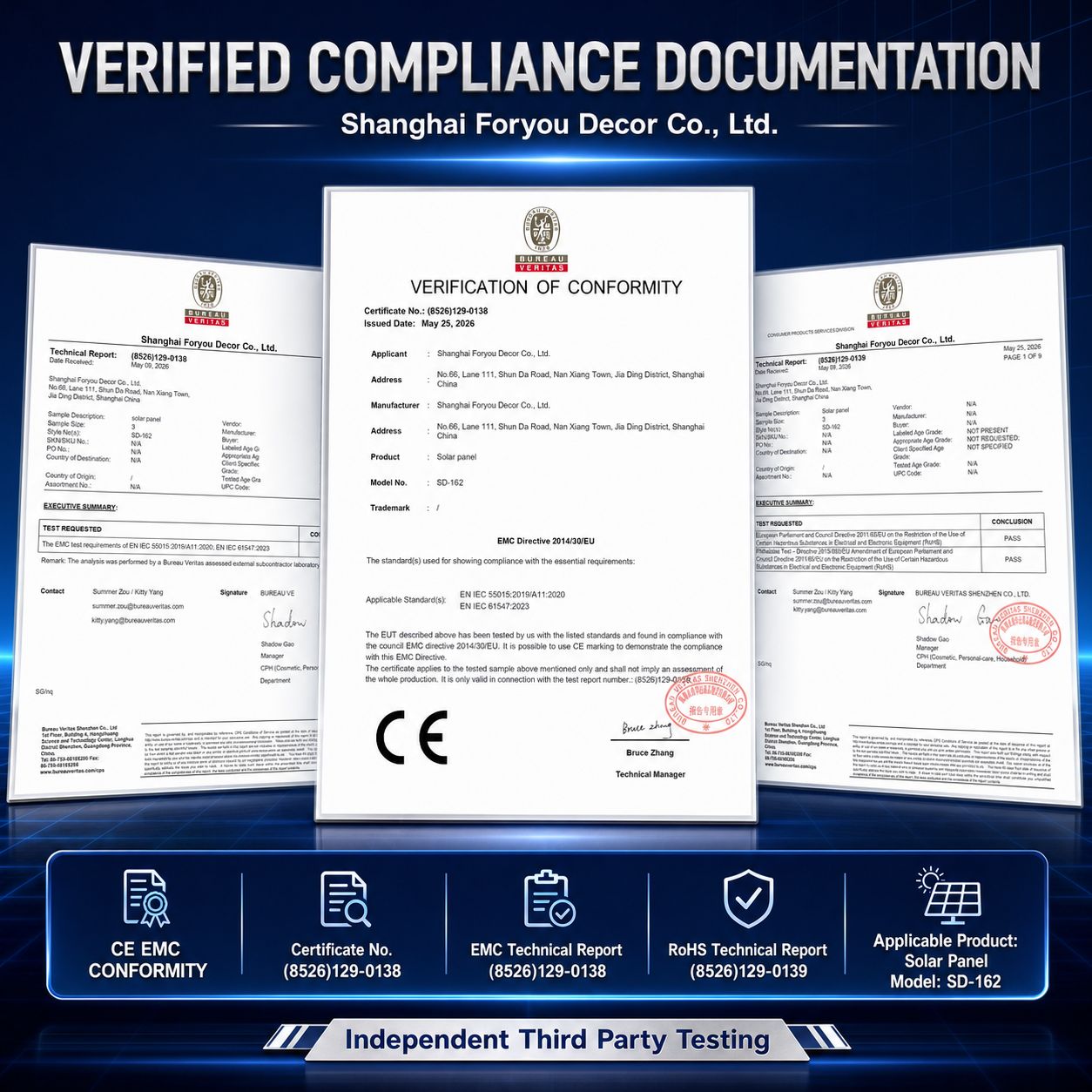
No. Compliance must be mapped to the finished product and the legislation that actually applies. When an EU declaration of conformity is required, it should identify the finished model rather than relying only on component certificates.
Provide the target retail channel and price, intended winter claim, lantern size range, finish, motif plan, battery preference, serviceability requirement, packaging channel and required EU documents. These inputs should precede tooling and quotation finalisation.
Buy the energy balance, verification method and change-control discipline—not the marketing adjectives. For Poland, the lower-risk assortment is a small number of shared bodies with measured solar input, low and documented LED consumption, replaceable batteries, component-level material disclosure, separate ingress and condensation controls, stable packaging and a model-specific compliance file. Treat 7.5 cm, 9 cm and 11 cm only as nominal geometry until electrical performance is verified.
Foryou Decor develops OEM and ODM memorial-lighting programmes for importers, wholesalers and retail buyers. A productive specification review begins with the market channel, intended winter claim, target retail position, panel output, LED load, material map, battery strategy, packaging route and required EU documentation. Defining these inputs early reduces costly changes after tooling and sample approval.
• Statistics Poland — Population size, structure and vital statistics in 2025
• Statistics Poland — Socioeconomic situation of voivodships, 2025 data
• ORPEG — All Saints’ Day and All Souls’ Day in Polish tradition
• European Commission JRC PVGIS — Monthly radiation data for Warsaw
• JRC PVGIS — Monthly radiation methodology
• EUR-Lex — General Product Safety Regulation (EU) 2023/988
• European Commission — RoHS Directive
• European Commission — EMC Directive
• EUR-Lex — Batteries Regulation (EU) 2023/1542
• European Commission — Low Voltage Directive
• Your Europe — EU declaration of conformity for the final product
• IEC — Ingress protection ratings
• Panasonic — Industrial rechargeable battery catalogue
• Murata — Rechargeable lithium-ion battery safety data
Methodology and limitation note: Retail observations are four selected pages checked on 31 July 2026; they are neither a probability sample nor evidence of sales, market share or national average pricing. Solar values are engineering estimates based on Warsaw PVGIS monthly averages, gross circular area, 16% conversion efficiency, a 70% system factor, no shade, no snow and a clean horizontal surface. They are not measurements of a finished lantern. Engineering thresholds are procurement starting points, not statutory standards. Compliance obligations depend on the final design, claims, economic-operator role and applicable law. This article is not legal advice or a certification decision.


 English