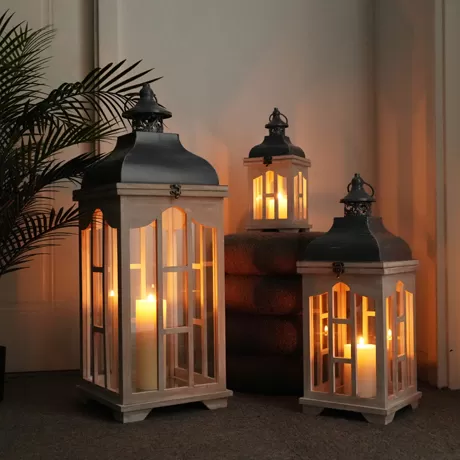
The global solar lantern market is experiencing unprecedented growth. According to the latest market research data, the global solar lantern market size is expected to reach $4.2 billion by 2025, with a compound annual growth rate of 11.9%. Behind this growth lie multiple driving factors, presenting enormous business opportunities for home decor enterprises.
1. Policy Support and Rising Environmental Awareness
Driven by the global "dual carbon" strategy, governments around the world have introduced policies supporting clean energy applications:
The Chinese government has included solar lighting in the rural energy revolution pilot county construction implementation plan
The EU has formulated strict carbon emission regulations to promote the transition from traditional lighting to solar energy
The United States offers solar product tax credits of up to 30% of the cost
These favorable policies create significant opportunities for home accent wholesale buyers seeking to expand their eco-friendly product offerings.
2. Technological Progress and Cost Reduction
The rapid development of photovoltaic technology has significantly improved product cost-effectiveness:
Monocrystalline silicon cell conversion efficiency increased from 18% in 2020 to over 23% in 2025
Lithium battery costs decreased by 40%, energy storage capacity increased by 35%
LED light source efficiency increased to 180lm/W, service life extended to 50,000 hours
3. Upgraded Consumer Demand
In the post-pandemic era, consumers have significantly increased their focus on outdoor living spaces:
The global outdoor furniture market grew by 28%, driving demand for supporting lighting
The increasing popularity of smart homes has driven demand for intelligent solar lanterns
Younger consumers are more inclined to choose environmentally sustainable products
North American Market: Emphasizes product quality and smart features, with the highest average customer unit price
European Market: Strong environmental awareness, prefers products with strong design sense
Asia-Pacific Market: Fastest growing, with high price sensitivity
Emerging Markets: Significant demand for off-grid solar lighting in areas with underdeveloped infrastructure
Solar lanterns from leading solar lantern factory have significant environmental and economic advantages compared to traditional grid-powered lighting, and these advantages are driving a global market transformation.
Environmental Benefit Comparison
Comparison Item | Solar Lanterns | Traditional Grid Lighting | Environmental Advantage |
Annual Carbon Emissions | Near zero | 1-2 tons/unit | Over 90% reduction |
Energy Source | Solar energy (renewable) | Mainly fossil fuels | 100% clean energy |
Product Lifespan | 8-10 years | 3-5 years | 50% reduction in waste |
Recyclability | 90% of components recyclable | 30% of materials recyclable | Significant reduction in e-waste |
Data Source: U.S. Department of Energy 2025 Sustainable Lighting Report
Economic Benefit Analysis
Initial Investment Comparison:
Solar lanterns: $80-200/unit (one-time investment)
Traditional lighting: $30-80/unit (excluding installation costs)
Operating Cost Analysis (based on 10-year service life):
Solar lanterns: 0 electricity + 50-100 maintenance = $50-100
Traditional lighting: 200-400 electricity + 150-300 maintenance = $350-700
Return on Investment (ROI):
Year 1: Save $20-40 on electricity bills
Year 3: Cumulative savings of $60-120, recovering most of the investment
Year 10: Net savings of $250-600, ROI exceeding 300%
Functional Advantages
Easy Installation:
No grid connection required, can be installed anywhere
No professional electrician needed, DIY installation possible
High mobility, can be adjusted according to needs
Safety Performance:
Low-voltage DC power supply, no electric shock risk
Waterproof rating up to IP65, suitable for harsh outdoor environments
Intelligent control system, automatically adjusts brightness and on/off
Intelligent Features:
Light sensor control: Automatically turns on at dusk, off at dawn
Motion sensor: Automatically increases brightness when someone passes by
Mobile APP control: Remote brightness adjustment and timer settings
Voice control: Supports smart assistants like Alexa and Google Home
Faced with the wide variety of solar lantern products on the market, consumers need to make informed choices based on usage scenarios, functional requirements, and budget considerations. This guide will help consumers quickly find the most suitable product.
Buying by Usage Scenario
1. Garden and Courtyard Lighting
Recommended Product Types:
Path Lights: 60-90cm height, providing guiding illumination
Lawn Lights: Diverse styles, strong decorative effect
Spotlights: Used to highlight landscape features
Key Parameters:
Light intensity: 100-300lm
Irradiation distance: 5-15 meters
Continuous rainy weather working time: 3-5 days
Foryou Decor Recommended Products:
Solar Lantern SD-047: Classic retro design, suitable for traditional style gardens
Solar Lantern SD-051: Modern minimalist style, IP65 waterproof rating
2. Patio and Balcony Lighting
Recommended Product Types:
Hanging Lanterns: Space-saving, creating a warm atmosphere
Tabletop Lanterns: Easy to move, can be used as decoration centerpieces
Wall Lights: Mounted on walls, saving floor space
Design Points:
Choose products that coordinate with furniture style
Consider light color temperature, warm light creates a cozy feeling
Focus on the weather resistance of product materials
3. Outdoor Security Lighting
Functional Requirements:
Motion sensor function, automatically turns on when someone is present
Sufficient brightness (over 300lm)
Long battery life to ensure nighttime safety
4. Camping and Outdoor Lighting
Portability Requirements:
Lightweight, easy to carry
Multi-functional design, can be used as a flashlight
USB charging function, can charge mobile phones and other devices
Technical Parameter Interpretation
Solar Panels:
Monocrystalline silicon: High conversion efficiency, relatively high price
Polycrystalline silicon: Good cost-performance, widely used
Amorphous silicon: Flexible design, suitable for special shapes
Battery Types:
Nickel-cadmium batteries: Low price, but with memory effect
Nickel-metal hydride batteries: Stable performance, good environmental friendliness
Lithium batteries: Large capacity, long lifespan, relatively high price
Light Source Types:
LED: Energy-saving and efficient, long service life
CFL: Average light efficiency, gradually being phased out
Incandescent: High power consumption, basically withdrawn from the market
Buying Considerations
1. Waterproof Rating: At least IP44 rating for outdoor use, IP65 recommended for harsh environments
2. Lighting Time: Choose appropriate solar panel power based on local sunlight conditions
3. After-sales Service: Choose home decoration factory with comprehensive after-sales support
4. Certification Standards: Priority to products passing international certifications such as CE and RoHS


 English
 français
 Deutsch
 italiano
 русский
 العربية
 Türkçe
 čeština
 dansk
dansk Suomi
Suomi Polska
 magyar
 Svenska
 norsk
norsk română
 slovenský