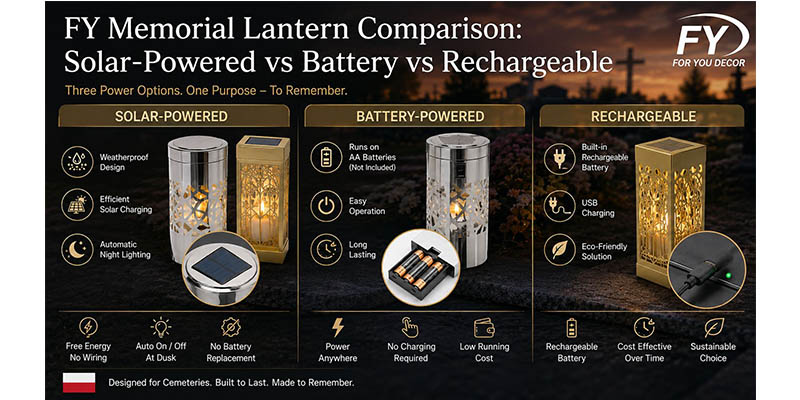
Decision Summary
For an individual outdoor grave with adequate sunlight, no approved electrical connection and limited access for maintenance, a solar memorial light is usually the most practical choice. A replaceable-battery memorial light is often better for deeply shaded plots, short-term tributes or locations where predictable operation is more important than automatic solar charging. A wired electric light is best reserved for professionally planned cemetery paths, memorial walls, entrances, indoor remembrance spaces or other permanent installations with approved electrical infrastructure.
Before comparing brightness, price or design, always confirm what the cemetery permits.
Editorial Disclosure
Foryou Decor manufactures cemetery lanterns, including solar-powered models. To keep this guide useful rather than promotional, all three power systems are evaluated using the same criteria: cemetery rules, sunlight, installation, maintenance, weather exposure, serviceability, appearance and total cost of ownership.
Criterion | Solar | Replaceable Battery | Wired Electric |
Power source | Solar panel charging an internal rechargeable battery | Replaceable cells or manually rechargeable battery pack | Fixed low-voltage or mains electrical supply |
Wiring required | No | No | Yes |
Depends on sunlight | Yes | No | No |
Installation complexity | Low | Low | High |
Routine maintenance | Low to moderate | Moderate to high | Usually low after professional installation |
Best application | Sunny individual graves and wire-free memorial gardens | Shaded graves, temporary use and seasonal remembrance | Cemetery paths, entrances, memorial walls and managed sites |
Main limitation | Charging varies with available sunlight | Batteries must be replaced or recharged | Requires permission, cabling and professional installation |
Typical buyer | Families, memorial retailers, distributors and importers | Seasonal retailers and users with shaded sites | Cemetery operators, institutions and landscape contractors |
There is no universal winner. The correct choice depends on the site and the maintenance reality.
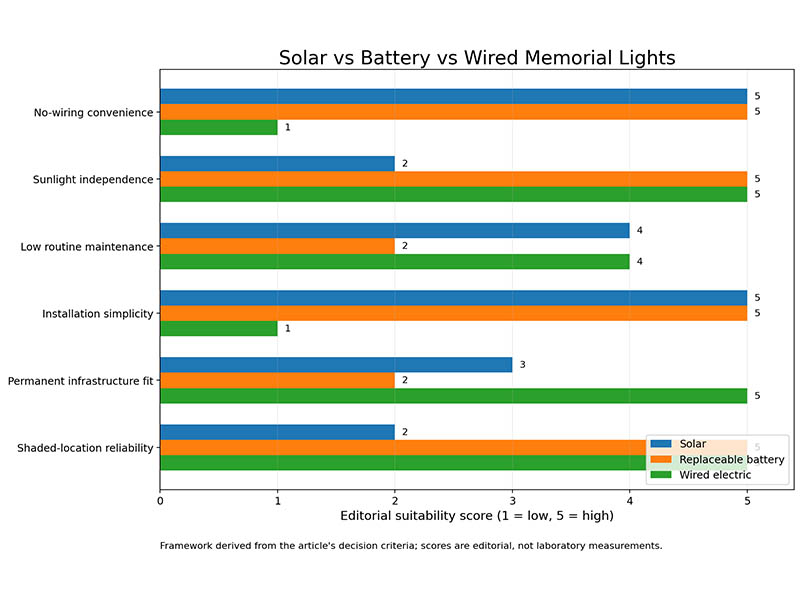
Figure 1. Solar vs battery vs wired memorial lights across six buying criteria.
Editorial suitability framework; scores are not laboratory measurements.
The first question is not whether solar, battery or electric is better. The first question is whether the cemetery allows the product at all.
Policies may regulate:
Lantern size and placement;
Freestanding or ground-stake decorations;
Glass and metal products;
Electrical cables and permanent fixtures;
Decoration periods around religious holidays;
Seasonal clearing schedules;
Open flames or candle-style products;
Items that extend beyond the grave boundary.
A technically suitable light can still be removed when it conflicts with cemetery policy. Buyers should therefore use the following decision order:
Confirm that memorial lighting is permitted.
Confirm the allowed material, size and installation method.
Evaluate sunlight and shade.
Assess how frequently someone can visit the grave.
Compare maintenance and total ownership cost.
Select the design, light effect and product finish.
For wholesale buyers, cemetery rules should also influence the product assortment. A retailer serving several European markets may need compact freestanding lanterns, low-profile grave candles and stake-mounted lights rather than one universal design.
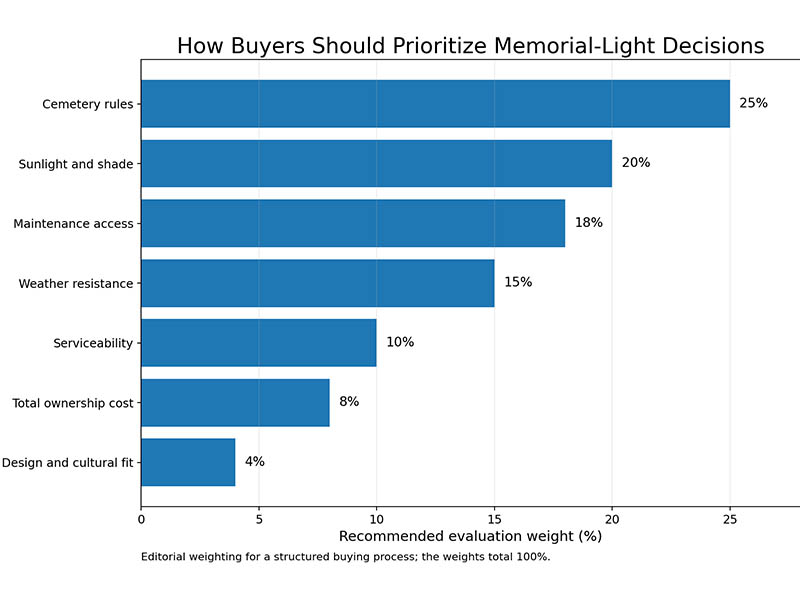
Figure 2. Recommended weighting for memorial-light buying decisions.
Editorial weighting; buyers should adjust the percentages for local cemetery rules and market requirements.
The three categories must be defined accurately before they can be compared.
A solar memorial light normally includes:
A photovoltaic panel;
An internal rechargeable battery;
An LED light source;
A charging and control circuit;
A light sensor or timer, depending on the design;
An outdoor enclosure.
The solar panel charges the internal battery during the day. Stored energy then powers the LED after dark.
This category should not simply be described as "solar rather than battery," because a solar light also contains a battery. The important distinction is that the battery is recharged by an integrated solar panel rather than being routinely replaced or manually charged.
Solar performance depends on the complete system - not merely the panel. Panel size, battery specification, LED load, sensor stability, enclosure design and local sunlight must work together.
These lights use replaceable AA, AAA, C, D or button cells, or a battery pack that must be removed and recharged.
They operate independently of sunlight and are often sold in candle, vigil-light or compact lantern formats. They can provide predictable operation when the batteries are fresh, but someone must eventually open the product and replace or recharge them.
"Electric" should be defined more precisely as either a professionally installed low-voltage lighting system or a mains-powered indoor or protected memorial lamp.
These systems are not equivalent to a portable grave lantern. Wired lighting is generally a site-level infrastructure solution rather than a product placed casually on an individual grave.
Solar memorial lights are most suitable when the user needs a wire-free product that can remain outdoors and operate with limited day-to-day attention.
No External Wiring. A solar grave light does not require trenching, a transformer or access to the cemetery's electrical supply. This makes it practical for individual plots and remembrance gardens where electrical installation is unavailable or prohibited.
Automatic Daily Operation. A properly configured model can charge during daylight and illuminate after dark without being switched on during every visit.
Lower Routine Servicing. Solar models avoid the frequent replacement of disposable cells required by continuously used battery lights. They are not maintenance-free, but routine work is usually limited to keeping the panel clean, checking seals and replacing serviceable components when necessary.
Strong Decorative Flexibility. Solar modules can be integrated into traditional grave candles, crosses, angels, plaques and lantern-style products. This gives retailers and distributors more design options than a purely functional lighting fixture.
Solar should not be recommended automatically when:
The grave remains under heavy tree cover;
A monument permanently shades the panel;
The lantern will be placed below surrounding decorations;
Winter daylight is limited and the product has insufficient energy storage;
The solar panel cannot face an open section of sky;
The buyer requires guaranteed continuous brightness regardless of weather.
Photovoltaic output depends on usable solar access. Shaded modules cannot collect energy optimally, and a small memorial-light panel is especially sensitive to poor placement.
Individual graves with reasonable sunlight;
Family-maintained memorial plots;
Wire-free remembrance gardens;
Permanent outdoor memorial displays;
Premium retail products marketed around convenience and reusable design;
Cemetery sections where electrical installation is unavailable.
Battery-powered memorial lights solve a different problem. Their primary advantage is independence from sunlight.
Immediate operation after installation;
Predictable performance when fresh batteries are installed;
Suitable for shaded or enclosed locations;
Low initial cost in simple candle formats;
Familiar appearance for traditional remembrance occasions;
Practical for temporary, anniversary or seasonal use.
The apparent simplicity of a battery light can create long-term maintenance work. When the battery is depleted, someone must return to the site, open the enclosure, remove and dispose of or recharge the old battery, install the replacement and reseal the product correctly.
Repeated opening may increase the chance of incorrect sealing, moisture entry or damaged contacts. For a single grave visited regularly, this may be acceptable. For a retailer, cemetery operator or project involving hundreds of units, battery replacement labor can become more important than the original product price.
Deeply shaded graves;
Indoor or covered memorial areas;
All Saints' Day and other seasonal retail programs;
Temporary tributes;
Buyers who value predictable short-term operation;
Users who consider periodic replacement part of the remembrance ritual.
Battery products should not be dismissed as inferior. They are often the more reliable choice in locations where solar charging cannot be supported.
Wired electric lighting provides the most stable power source, but it is rarely the simplest choice for an individual grave.
Cemetery entrances;
Public paths and steps;
Memorial walls;
Chapels and indoor remembrance rooms;
Shared monuments;
Professionally managed memorial parks;
Architectural lighting included in the original site design.
Stable operation independent of sunlight;
Centralized control;
Higher available power where stronger illumination is required;
Integration with timers, controls and site-wide lighting plans;
Centralized maintenance for large institutional sites.
Requires cables, transformers or mains access;
May require trenching and professional electrical work;
Must comply with local electrical and cemetery requirements;
Has a higher installation cost;
Is difficult to relocate;
Is disproportionate for most individual graves.
For ordinary graveside use, wired lighting is generally an infrastructure solution to a product-level problem.
Catalog photographs do not show how a memorial light will perform after months of exposure. Buyers should evaluate the following conditions.
For solar products, the panel should not be hidden by the headstone, trees and shrubs, artificial flowers, wreaths, adjacent lanterns, snow, dirt or fallen leaves. The panel position matters as much as the lantern's appearance.
An outdoor lantern should be evaluated for more than rainfall alone. Buyers should check:
Water entry around the roof and solar-panel frame;
Sealing around glass panels;
Drainage at the base;
Condensation inside the enclosure;
Protection of battery contacts and the LED module;
The effect of repeatedly opening the access door.
An IP claim should be supported by an actual test method and report rather than used only as marketing language.
Winter can affect solar memorial lights in two ways: shorter and weaker daylight can reduce charging, and low temperatures can affect battery output and charging behavior.
A reliable supplier should state the working-temperature range and provide runtime data under defined test conditions rather than quoting one ideal laboratory number.
Freestanding cemetery lanterns need a stable base and a placement surface that is level enough to prevent movement. Buyers should also evaluate the center of gravity, door closure and overall weight.
A visually attractive lantern may still create after-sales problems when the battery, LED or control module cannot be accessed. For longer product life, ask:
Can the rechargeable battery be replaced?
Can the LED module be serviced?
Can the solar top be replaced separately?
Are instructions available in the target-market language?
Can spare parts be supplied after the initial order?
A useful cost comparison should not rely on generic retail prices. Prices vary significantly by material, market, packaging and order volume.
Cost Formula
Product cost + cleaning or inspection + rechargeable-battery or component replacement + failed-unit replacement
Cost Formula
Product cost + replacement batteries + travel or labor for battery changes + failed-unit replacement
Cost Formula
Fixtures + transformer + cable + trenching + professional installation + electricity + repairs and inspection
A simple battery candle may have the lowest purchase price, but repeated battery replacement can make it less economical when used every night. A solar lantern may cost more initially, but it avoids routine disposable-battery purchases and electrical installation. A wired system can provide good long-term value when infrastructure costs are shared across a managed cemetery site.
For B2B buyers, total cost should also include packaging breakage, return rate, replacement-part availability, quality-control labor, seasonal inventory risk, customer-support costs, product lifespan and repeat-purchase behavior.
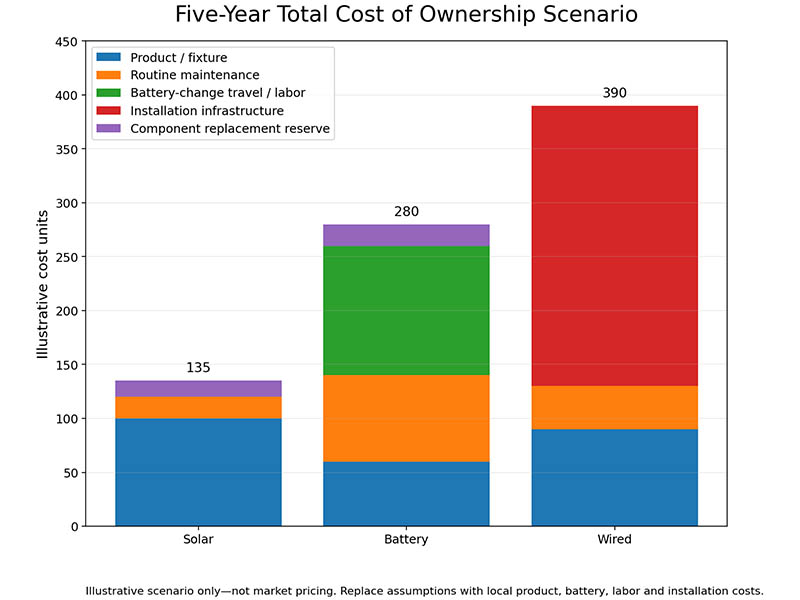
Figure 3. Illustrative five-year total cost of ownership scenario.
Illustrative scenario only - not market pricing. Replace the assumptions with local product, battery, labor and installation costs before publication or sales use.
Use Case | Recommended Type | Reason |
Sunny individual grave | Solar | Wire-free operation and lower routine maintenance |
Grave under dense trees | Battery | Does not depend on solar access |
Temporary anniversary tribute | Battery | Low commitment and immediate operation |
Permanent wire-free remembrance garden | Solar | Suitable for distributed, independent placement |
Cemetery entrance or pathway | Wired electric | Centralized power and professional site management |
Indoor memorial room | Wired or battery | No need to depend on outdoor solar charging |
Seasonal low-price retail program | Battery | Familiar format and lower entry price |
Premium European grave-lantern assortment | Stainless steel solar lantern | Traditional lantern styling with wire-free lighting |
Large institution-managed cemetery | Wired, solar or hybrid | Final choice depends on infrastructure and site zones |
A hybrid product strategy is often best for distributors. Solar and battery models should serve different site conditions and price levels rather than being presented as identical alternatives.
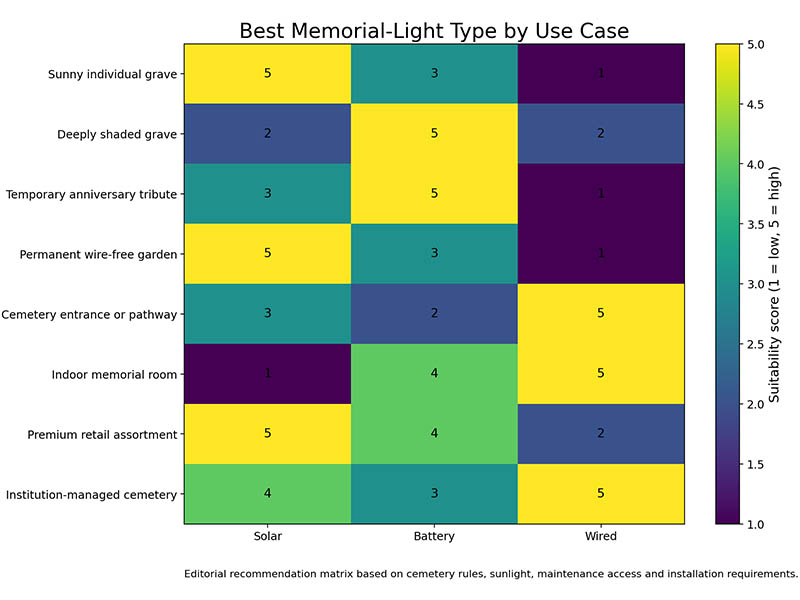
Figure 4. Memorial-light recommendation matrix by use case.
Editorial recommendation matrix based on cemetery rules, sunlight, maintenance access and installation requirements.
The Foryou Decor Cemetery Lantern ML-6004 is a relevant example of how solar technology can be integrated into a traditional European-style grave lantern.
Specification | ML-6004 |
Product type | Solar-powered memorial cemetery lantern |
Item number | ML-6004 |
Main materials | Stainless steel and glass |
Product size | 13 x 13 x H21 cm |
Standard packaging | Brown box |
Custom packaging | Available |
Quantity per outer carton | 12 pieces |
Outer-carton size | 58 x 54 x 24 cm |
20GP loading quantity | 4,392 pieces |
40GP loading quantity | 9,096 pieces |
40HQ loading quantity | 10,380 pieces |
The official product information describes a stainless steel and glass lantern with an integrated solar configuration, defined export packaging and custom-packaging availability. Its material and form position it as a more permanent and premium visual alternative to a basic plastic grave candle.
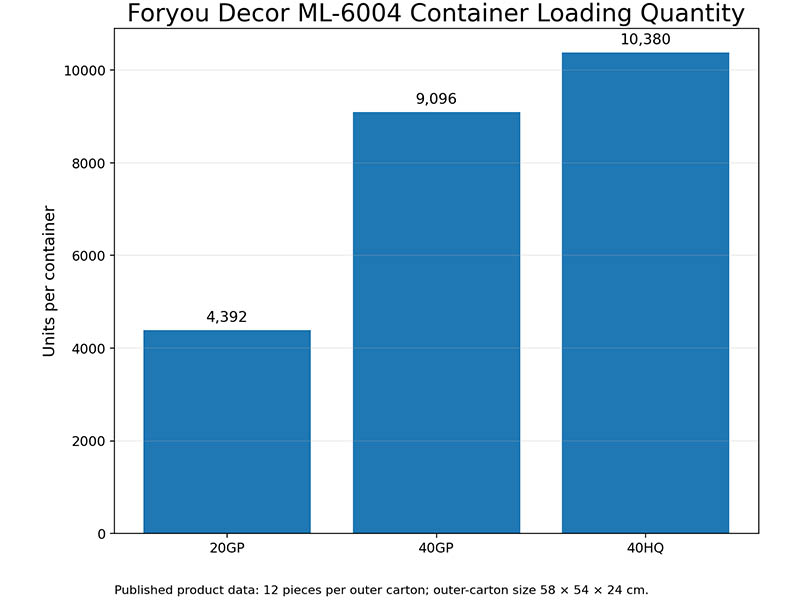
Figure 5. Foryou Decor ML-6004 container loading quantity.
Published ML-6004 product data: 12 pieces per outer carton; outer-carton size 58 x 54 x 24 cm.
For cemetery products, material choice affects both appearance and long-term retail positioning. A stainless steel and glass lantern can offer:
A dignified, architectural appearance;
Better premium-category positioning;
Clear visibility of the internal light source;
A traditional lantern form familiar to European buyers;
A reusable alternative to low-cost disposable formats;
Compatibility with silver, black, bronze or other memorial-product collections.
However, "stainless steel" should not automatically be interpreted as permanently rustproof. Corrosion resistance depends on the steel grade, surface finish, edges, fasteners, welding, coastal exposure and product maintenance.
Wholesale buyers should request confirmation of the stainless steel grade, surface treatment, salt-spray test conditions when relevant, glass type and thickness, panel and door sealing, drainage and condensation control, and fastener material.
Solar-panel type, dimensions and rated output;
Battery chemistry, voltage and capacity in watt-hours;
Whether the battery is replaceable;
LED color temperature or red/flame-effect option;
LED power and light output;
Charging time under defined irradiance;
Night runtime under defined temperature and brightness;
Dusk-sensor or timer configuration;
Tested ingress-protection rating;
Working-temperature range;
Relevant CE, RoHS, WEEE or battery documentation for the destination market;
Warranty and spare-part policy.
These specifications are more valuable than unsupported claims such as "all-night lighting," "completely waterproof" or "maintenance-free."
A visually attractive sample is only the beginning of supplier evaluation.
Do not compare products only by battery capacity or solar-panel size. The panel, battery, LED load, circuit and enclosure must be matched as one system.
Runtime data should identify the initial full-charge condition, light output or LED power, ambient temperature, daily operating hours, solar charging conditions and end-of-runtime definition. Without these conditions, a runtime claim cannot be compared fairly across products.
Roof and panel joints;
Door alignment;
Glass retention;
Base drainage;
Battery compartment;
Internal wiring;
Sharp edges;
Surface finish;
Stability on stone surfaces.
Glass and polished stainless steel require packaging that controls panel breakage, surface scratches, door deformation, internal movement and moisture during storage and transport. A packaging drop test and pre-shipment inspection should be part of the sourcing plan.
Entry-level battery grave candles;
Traditional red LED products;
Warm-white solar lanterns;
Flame-effect premium lanterns;
Stainless steel and glass memorial lanterns;
Cross, angel, rose and heart motifs;
Different sizes for mass retail and specialist memorial stores.
Foryou Decor supports bulk production, OEM and ODM projects, customized sizes, colors and finishes, logo and packaging customization, and pre-shipment quality inspection.
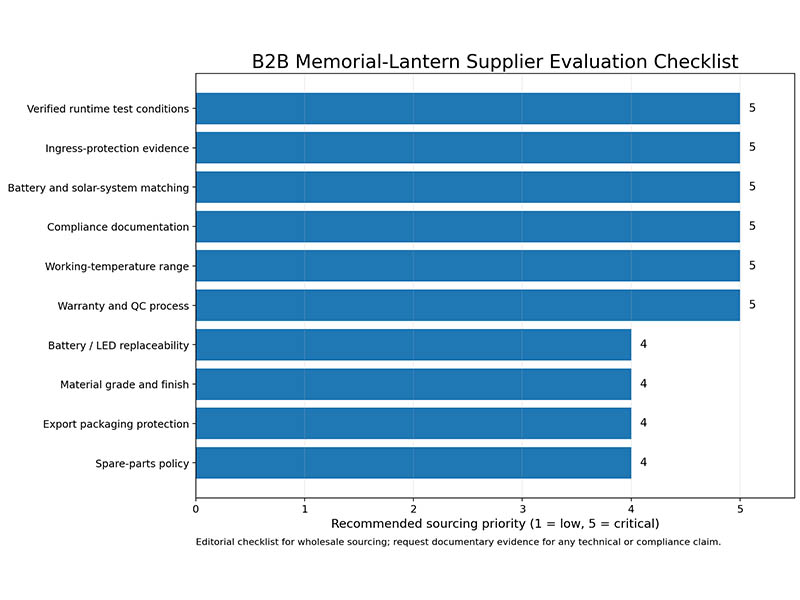
Figure 6. B2B memorial-lantern supplier evaluation priorities.
Editorial sourcing checklist; request documentary evidence for every technical or compliance claim.
What type of memorial light is best for most outdoor graves?
For an outdoor grave with adequate sunlight and no approved electrical connection, a solar memorial light is usually the most convenient option. Battery lights are better for deep shade or temporary use, while wired lighting is better for professionally managed cemetery infrastructure.
Do solar memorial lights work in shade?
They may charge in bright indirect light, but runtime and brightness usually decrease when the solar panel receives insufficient usable light. For a heavily shaded plot, a replaceable-battery light may provide more predictable performance.
Are solar grave lights maintenance-free?
No. They require less routine attention than many replaceable-battery products, but the panel still needs to remain clean, seals should be inspected and rechargeable batteries or electronic components may eventually require service.
How long should a solar memorial lantern stay illuminated?
There is no universal figure. Runtime depends on panel output, battery capacity, LED power, charging conditions, temperature and product settings. Buyers should request test data that states all of these conditions.
Is a stainless steel cemetery lantern completely rustproof?
Not necessarily. Performance depends on the stainless steel grade, surface treatment, fasteners, product construction and environmental exposure. Request material and corrosion-test documentation when the target market requires it.
Is a battery memorial light better for winter?
A battery light does not depend on short winter daylight, so it may be more predictable in shaded or low-sun conditions. However, battery performance can also be affected by low temperatures. The final choice should be based on product-specific testing.
Can wired electric lights be installed on an individual grave?
Only where the cemetery permits the installation and compliant electrical infrastructure is available. In most cases, wired lights are more appropriate for paths, entrances, memorial walls and institution-managed areas than for a single grave.
Is the Foryou Decor ML-6004 suitable for wholesale programs?
Its stainless steel and glass construction, solar configuration, defined carton packing and available custom packaging make it relevant to premium memorial and cemetery-lantern assortments. Buyers should still approve samples and confirm the required electrical, weather and compliance specifications before mass production.
What should buyers request with a product sample?
Request a component specification sheet, runtime test, battery information, solar-panel data, LED details, ingress-protection test, working-temperature range, packaging specification, compliance documents and available spare parts.
Final Recommendation
Choose solar for sunny individual graves, wire-free remembrance gardens and buyers who want lower routine maintenance. Choose replaceable battery for shaded plots, seasonal tributes and applications where operation must not depend on sunlight. Choose wired electric for permanent, professionally managed cemetery infrastructure.
The best decision begins with cemetery rules and site conditions - not with a generic claim about brightness or market popularity.
For importers, distributors and memorial-product retailers seeking a premium solar grave lantern, the Foryou Decor ML-6004 provides a stainless steel and glass format with established export-packing information and customizable packaging. The next step is to confirm the exact solar, battery, LED, weather-resistance and market-compliance configuration through samples and documented testing.
Call to Action
Request the ML-6004 specification sheet, product sample, packaging options and a market-specific quotation from Foryou Decor.
Foryou Decor - Cemetery Lantern ML-6004: https://www.foryoudecor.com/products/cemetery-lantern-ml-6004.html
Foryou Decor - Cemetery Lantern Category: https://www.foryoudecor.com/products/cemetery-lantern/
Foryou Decor - Product Catalogue: https://www.foryoudecor.com/products/
National Renewable Energy Laboratory - PV Site and Shading Guidance: https://www.nrel.gov/docs/fy10osti/48853.pdf
Google Search Central - AI Features and Your Website: https://developers.google.com/search/docs/appearance/ai-features
Google Search Central - Article Structured Data: https://developers.google.com/search/docs/appearance/structured-data/article
Generative Engine Optimization Research Paper: https://arxiv.org/abs/2311.09735
Figure 5 uses published ML-6004 loading data. Figures 1, 2, 4 and 6 are editorial decision frameworks. Figure 3 is an illustrative total-cost scenario and must not be presented as market pricing. Before public release, replace any generic author attribution with a named expert and add verified ML-6004 battery, solar-panel, LED, IP, working-temperature and compliance data where available.
Suggested Anchor Text | Target Page |
cemetery lantern collection | Cemetery Lantern product category page |
Foryou Decor ML-6004 | ML-6004 product page |
grave lantern manufacturer | Manufacturer capability page |
solar panels and LED lights for cemetery lanterns | Technical buying guide |
stainless steel lanterns | Stainless Steel Lantern category |
request a quote | Contact page |



 English
 français
 Deutsch
 italiano
 русский
 العربية
 Türkçe
 čeština
 dansk
dansk Suomi
Suomi Polska
 magyar
 Svenska
 norsk
norsk română
 slovenský